
Tape out sooner. Focus on results, not on code and waves.
Chipmind Agents handle design, integration, debugging and documentation tasks autonomously, so your engineers can focus on results and architecture. Flow-aware. SoC-wide. No lock-in.
Backed by & Featured in






Your engineers are too valuable to spend half their time on handholding coding agents.
01
The productivity gap
Agents promise 10X+ speed-up, yet engineers are stuck in chat panels and writing skills. Every sprint lost to manual RTL work is lost time-to-market you won't get back.
02
The issue with coding agents
Explaining complex chip design problems to AI coding agents properly takes a lot of precious engineering time, teaching it how things are done properly even longer.
03
The sovereignty issue
Relying on monopolies for AI-driven chip design and RTL generation compromises your architectural autonomy. True chip design independence requires a universal solution avoiding the loss of institutional knowledge which is missing in the long run.
Coding agents were not built for chip design.
The old way
AI Coding Agents
The new way
Chipmind Agents
IDE-bound, code-only
Independent workers
Runs inside your existing EDA flow, not just your IDE
Repo-wide context
SoC-wide context
Understands hierarchies and cross-file dependencies across all files
No EDA toolchain awareness
EDA toolchain integration
Runs lint, simulation, synthesis, and EDA scripts autonomously
No session memory
Persistent design context
Remembers your project, your conventions, your constraints
No visual intelligence
Multimodal Visual intelligence
Generates and reads block diagrams, FSMs, and RTL structures
Cloud-only
On-prem & air-gapped
Your IP stays in your environment. Cloud, VPC, or fully air-gapped
The new way
Chipmind Agents
Independent workers
Runs inside your existing EDA flow, not just your IDE
SoC-wide context
Understands hierarchies and cross-file dependencies across all files
EDA toolchain integration
Runs lint, simulation, synthesis, and EDA scripts autonomously
Persistent design context
Remembers your project, your conventions, your constraints
Generative UI - Multimodal Visual intelligence
Generates and reads block diagrams, FSMs, and RTL structures
On-prem & air-gapped
Your IP stays in your environment. Cloud, VPC, or fully air-gapped
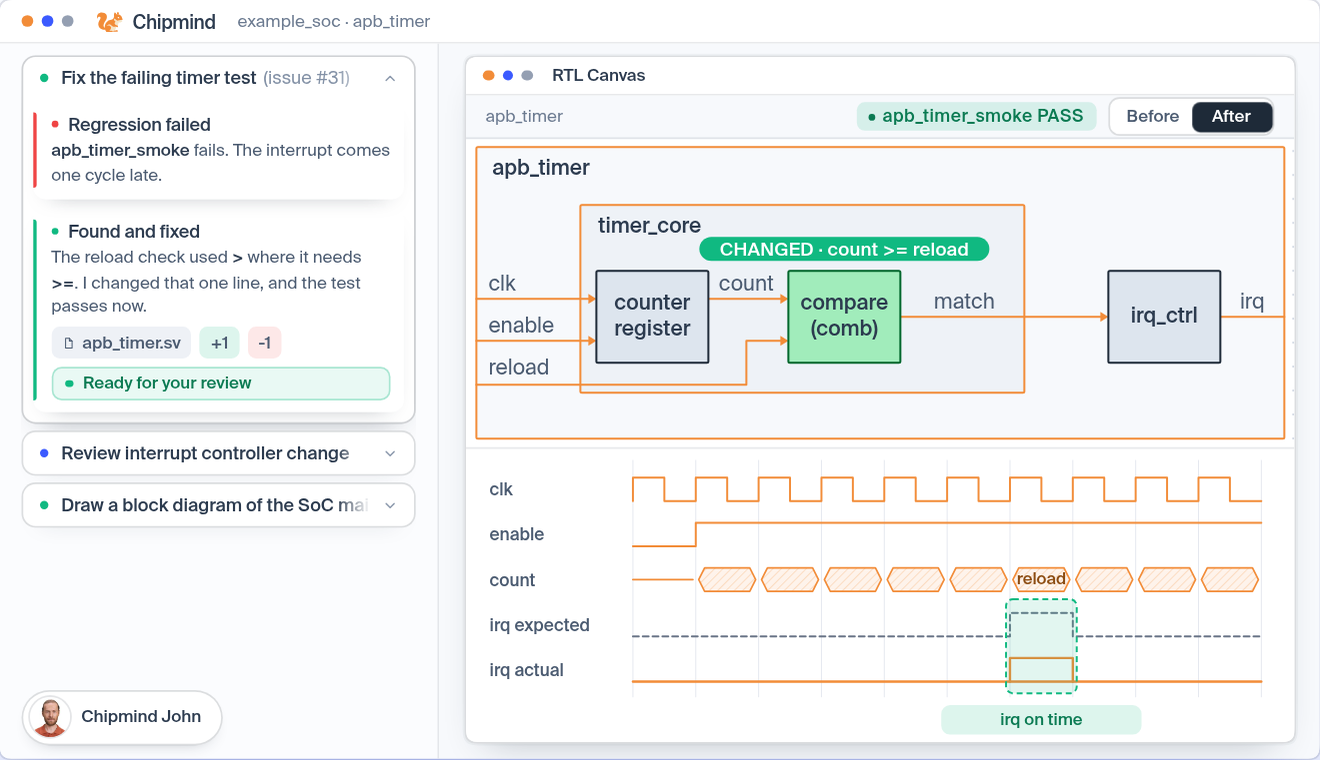
Meet Chipmind Agents. The first AI agent with a RTL Canvas as Generative UI.
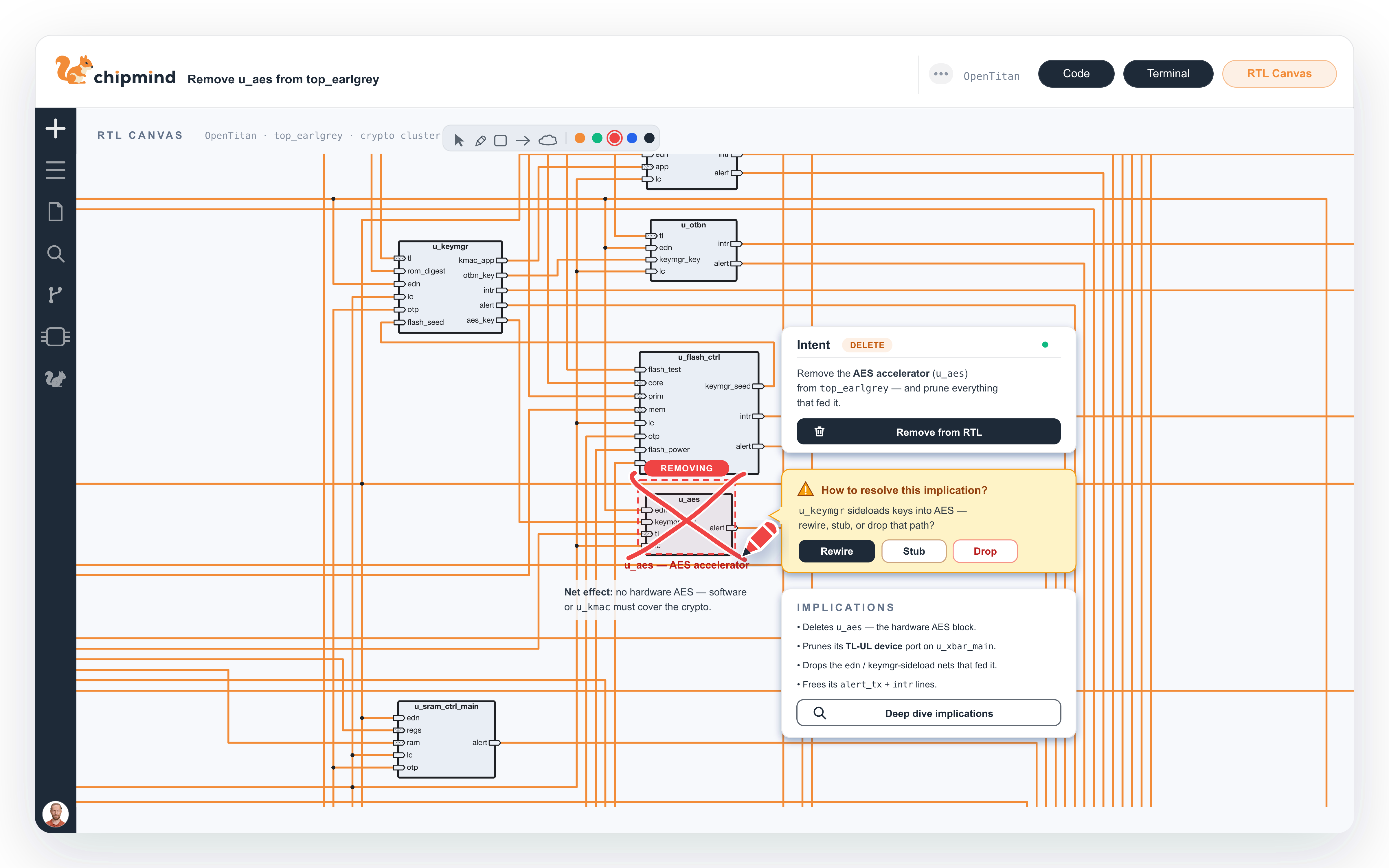
Chipmind Agents don't just suggest code. They understand your entire design database, plan tasks, execute them across your EDA environment, and report back. Interactive when you want oversight. Autonomous when you don't.
01
Flow-aware execution
Chipmind Agents run inside your existing EDA flow where your work is, not just your IDE
02
SoC-wide context
Understands hierarchies, cross-file dependencies and design intent with Chipmind Agent Harness
03
Generative UI
Visual intelligence through the RTL Canvas to deisgn, review and navigate block diagrams, FSMs, RTL structures and waveforms
Compatible with your existing stack.
EDA-tool agnostic. LLM-agnostic. If it has a scripting or CLI interface, Chipmind can use it.














From task to result in minutes.
No migration. No new EDA licenses.
Your environment, your tools.
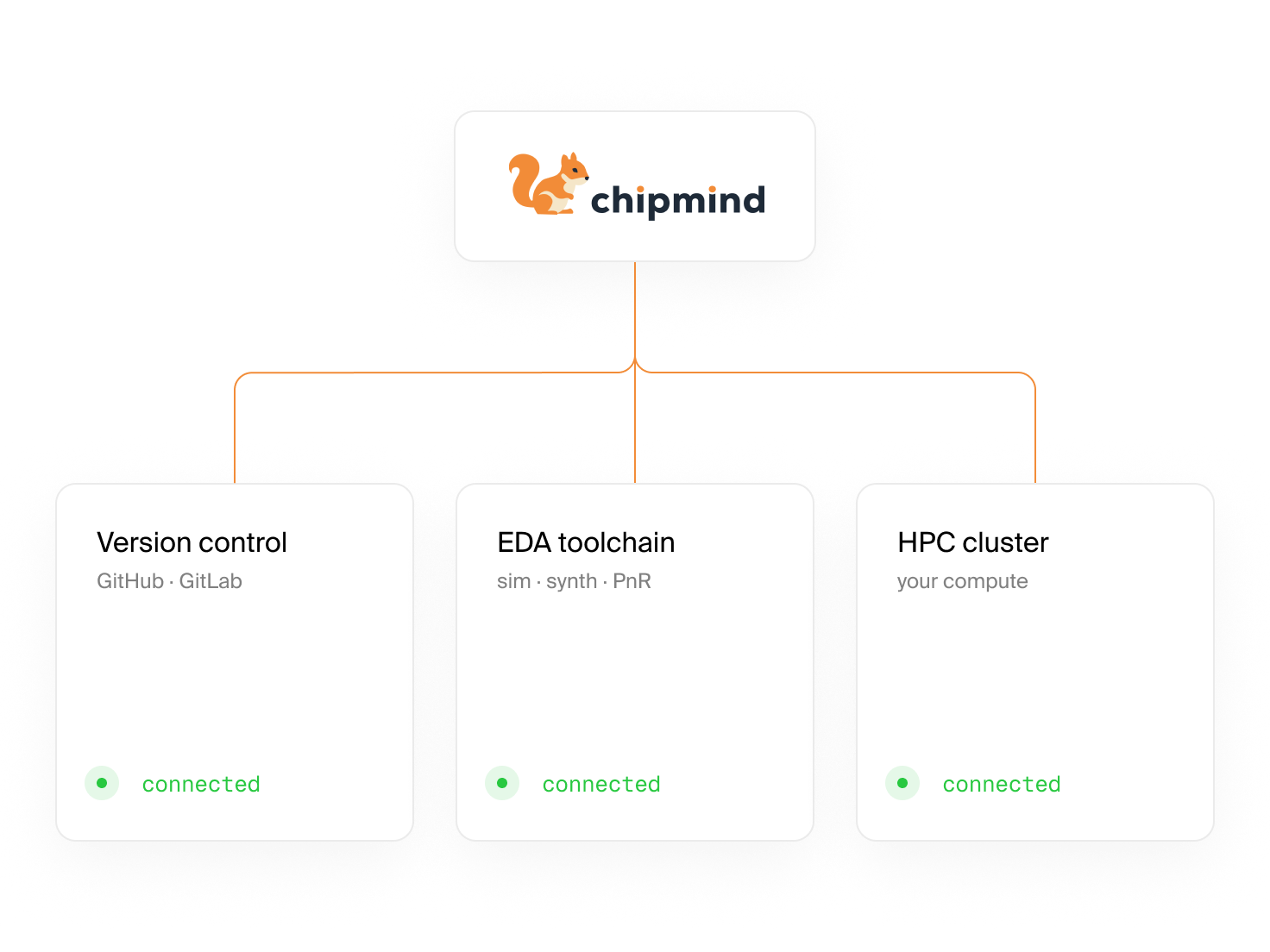
Chipmind connects to your existing VCS, EDA tools, and HPC cluster. On-prem, VPC, or cloud. Your choice.
Drop a task in plain English.
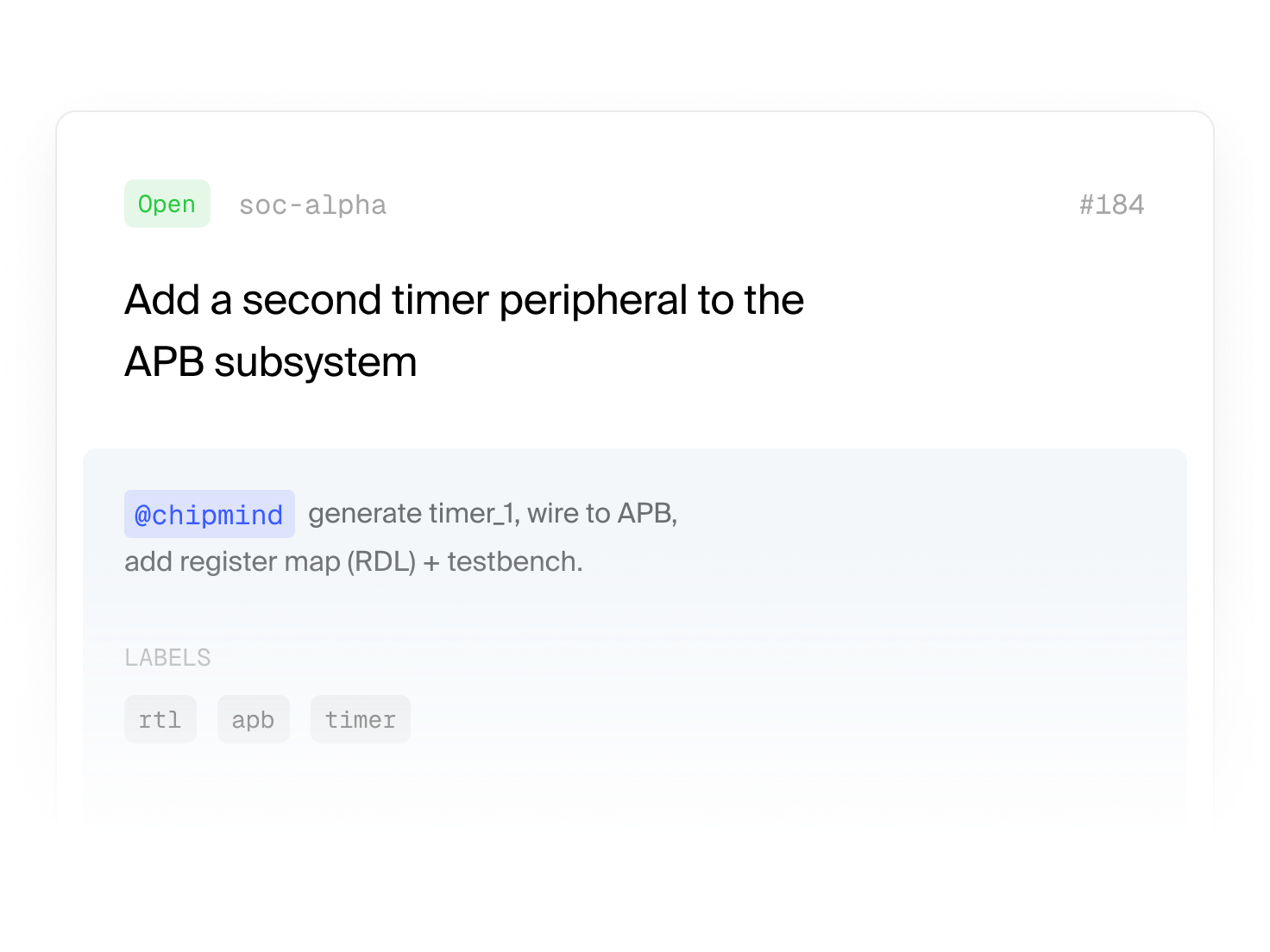
Open a GitHub issue, type an @mention, or use the Chipmind GUI. No new syntax and no scripts. Just describe what you need.
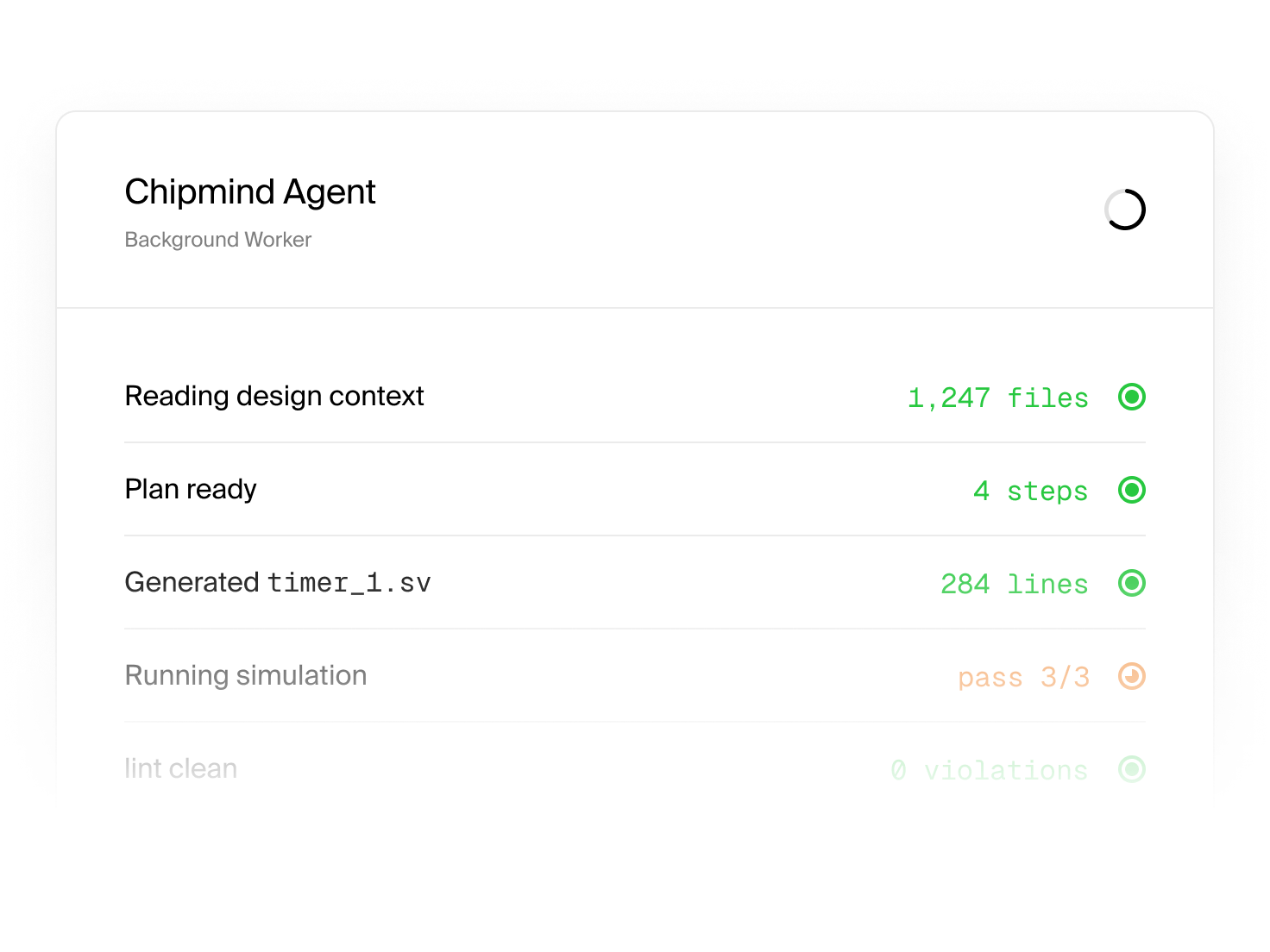
Agents plan and run it autonomously.
The agent reads your design context, plans the task, runs your EDA tools, and iterates until the result is correct.
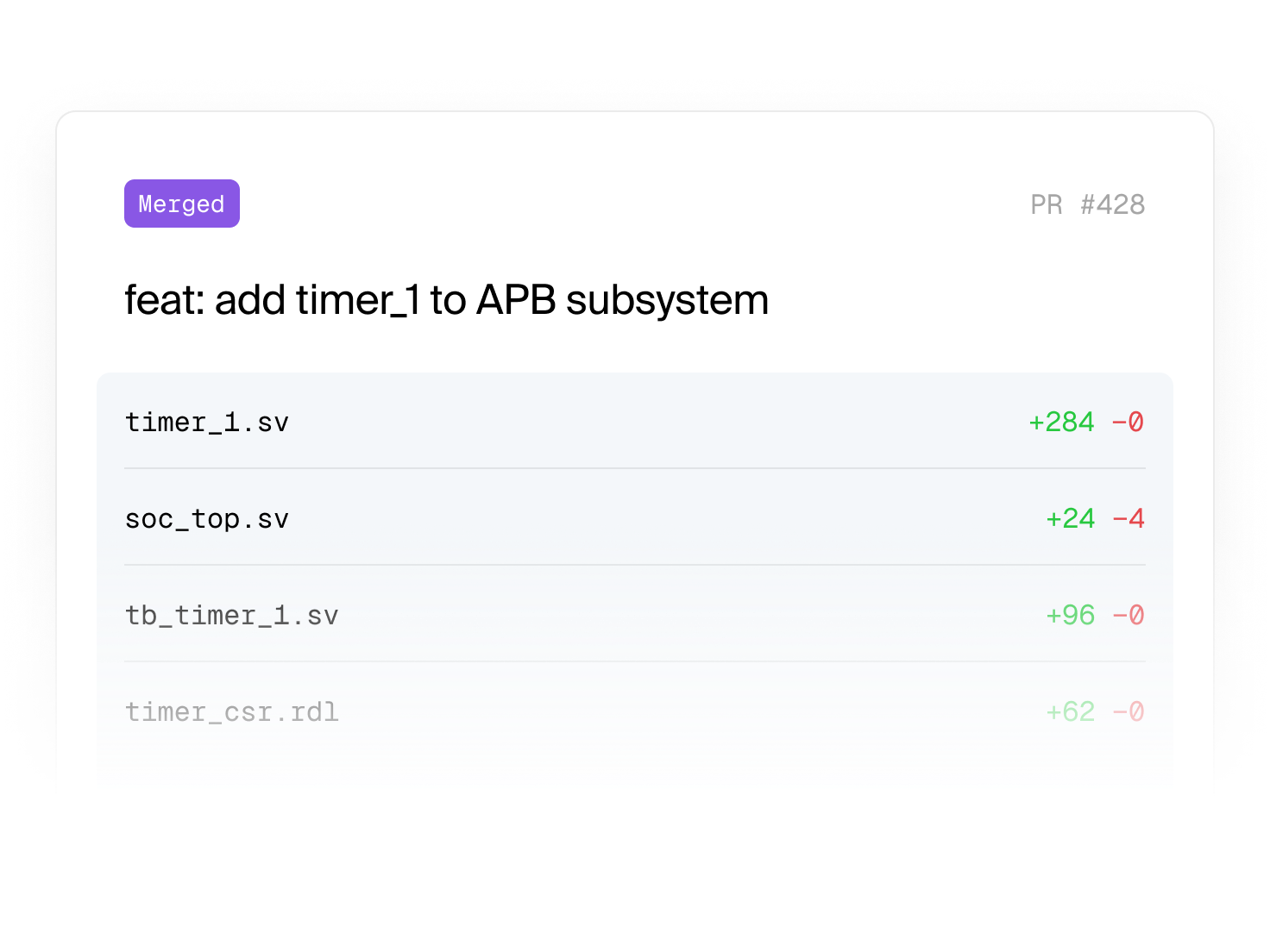
PR ready. Audit trail included.
Results come back as a reviewable PR with full execution log. You stay in control and your agents handle the work.
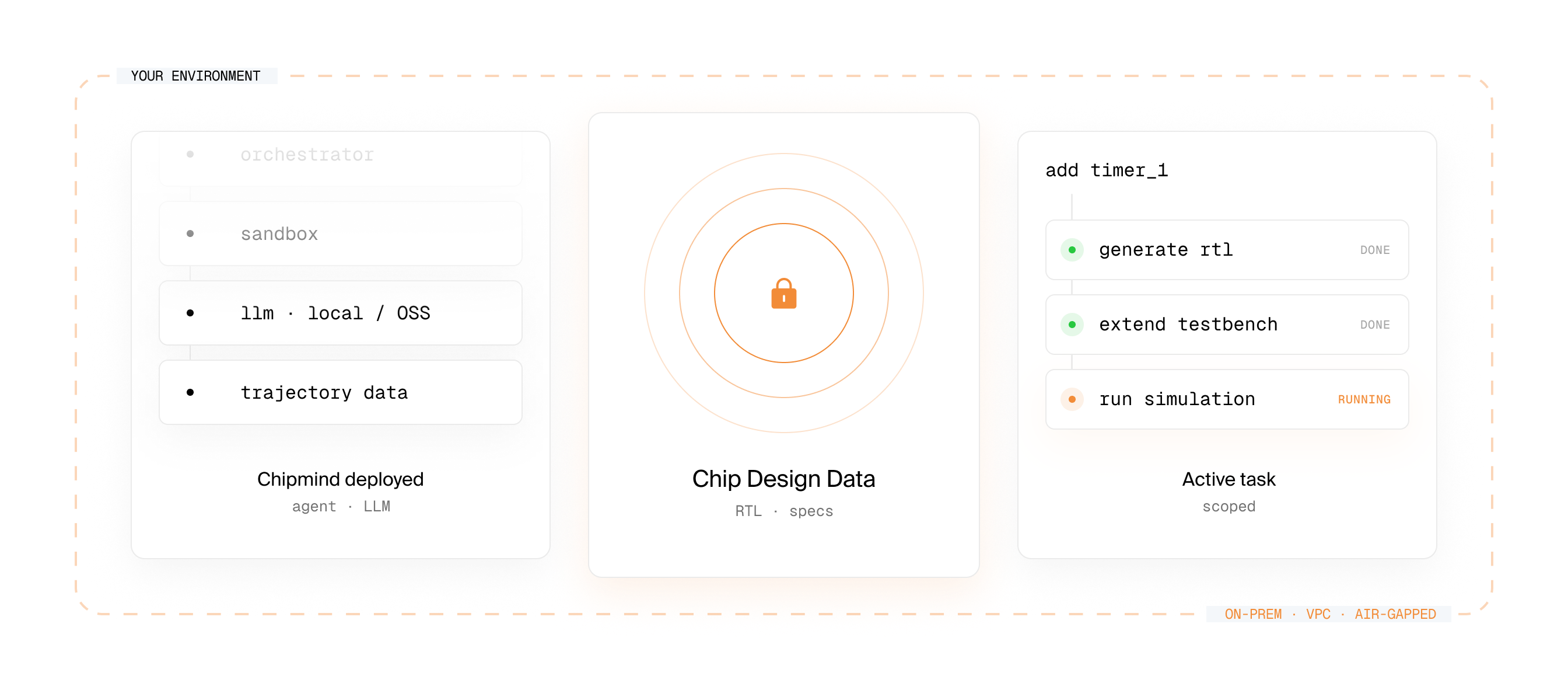
Your data and IP never leaves your premises.
The more your team uses Chipmind, the better it gets.
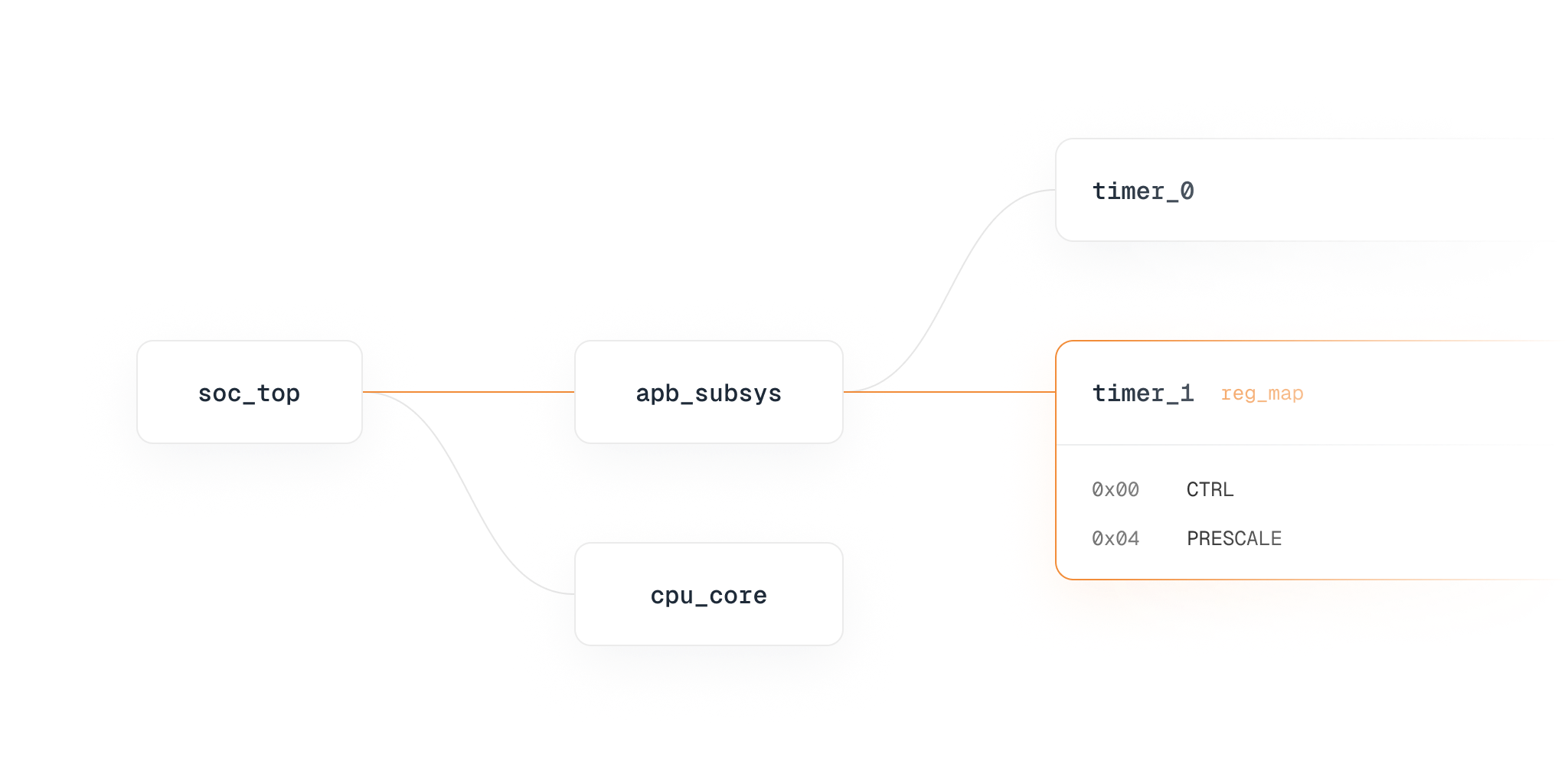
Your entire design hierarchy, not just one file.
Chipmind Agent Harness ingests your complete codebase, specs, and constraints. Agents dynamically retrieve hierarchies, register maps, and cross-file dependencies, building context that grows with every task.
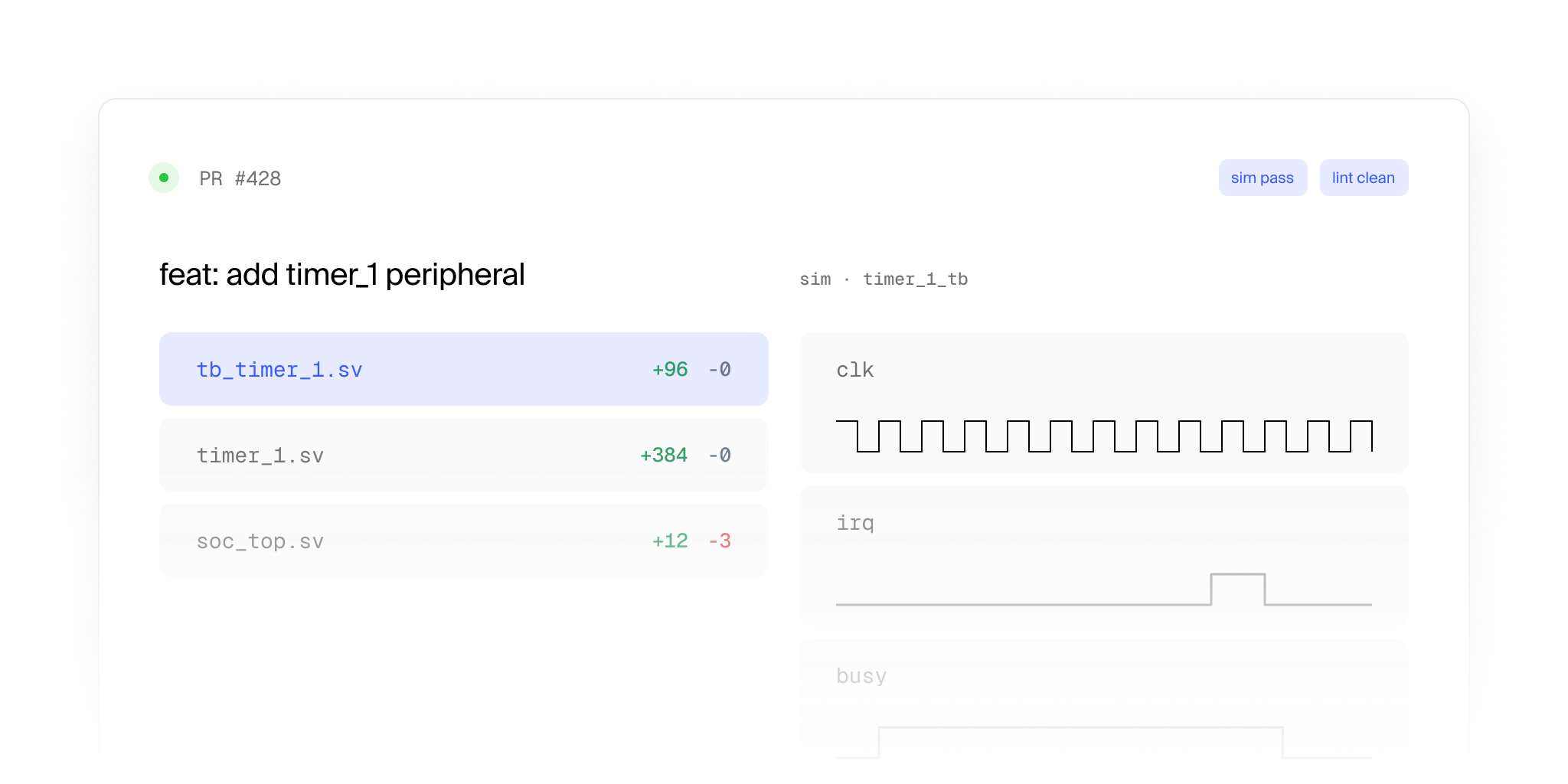
Your EDA tools. Reviewable results.
Agents write RTL, run simulations, analyze waveforms, and iterate autonomously. Every task produces committable code, block diagrams, and verification evidence, returned as a reviewable PR.
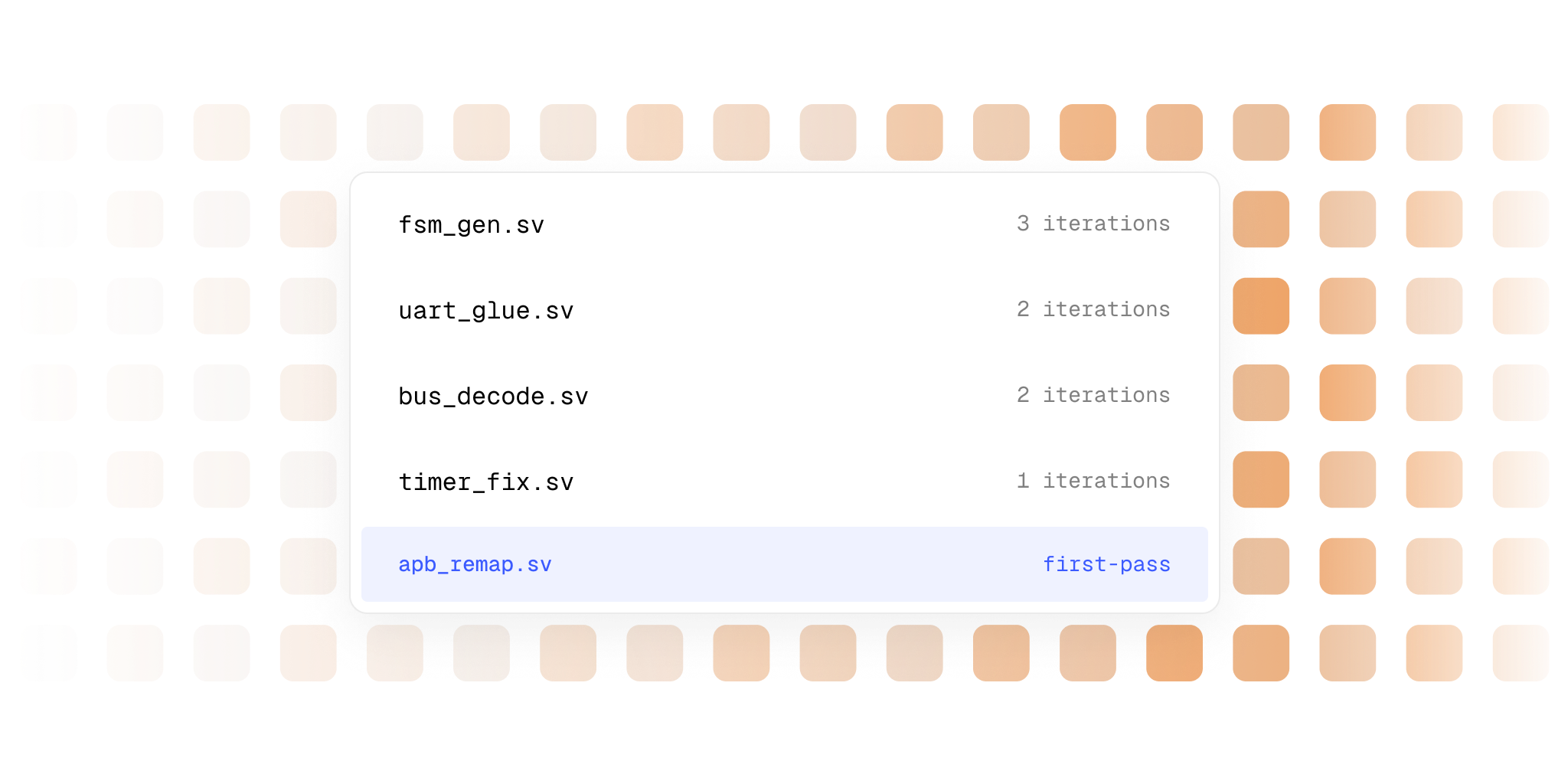
Your agent gets sharper with every task.
Every execution, successes and debugging paths, feeds back into Chipmind's proprietary chip-trajectory datasets. The longer it works with your flow, the better it gets.
Where to meet us
Come find us at these upcoming events.

FAQ
No, you do not need any internal AI or machine learning expertise to run or operate the platform. Chipmind is tailor-made specifically for chip design engineers. Our team handles all the technical heavy lifting during the setup phase, including deployment, configuration, and custom harness building within your secure environment. Once active, Chipmind’s self-adapting mechanisms automatically manage the underlying infrastructure, allowing your chip design and verification teams to collaborate with the autonomous agents seamlessly using natural design contexts and the interactive visual workspace.
Yes, Chipmind is fully engineered to run in completely air-gapped environments without any external internet or third-party API dependencies. To ensure seamless integration within highly restricted networks, our deployment includes custom harness building to securely bridge our design-aware agents with your isolated local codebases, repositories, and legacy EDA tools. This ensures that the platform, its underlying core engines, and all autonomous capabilities, including local verification and test harness building remain fully on-premise.
We design our evaluations to require minimal engineering overhead, typically needing just a few hours of initial coordination with your infrastructure team. During the initial setup phase, Chipmind engineers take care of the entire deployment, configuration, and heavy lifting directly within your secure environment. Because Chipmind is completely EDA tool-agnostic and features self-adapting mechanisms, our software automatically calibrates itself to your local scripts, simulators, and custom workflows. This allows your hardware engineers to immediately test the agents on real workflows and quickly demonstrate a tangible speed-up in development velocity, rather than managing a tedious integration.
Chipmind is completely EDA tool-agnostic, operating as an intelligent execution layer that integrates seamlessly into your established pipelines rather than forcing a toolchain replacement. The platform natively supports leading commercial suites from vendors like Synopsys, Cadence, and Siemens, alongside prominent open-source tools such as Yosys, Verilator, and OpenLane, as well as custom, in-house legacy automation scripts. By bridging directly with your local environment, Chipmind’s agents automatically feed generated RTL code to your underlying simulators and synthesizers, analyze the resulting error logs or digital waveforms, and use that real-time execution feedback to debug and refine hardware designs before they ever reach human review.
We protect your proprietary RTL and design data by deploying Chipmind entirely within your secure enterprise environment—whether on-premises or inside your private cloud—ensuring your sensitive source code never leaves your perimeter. All learning loops and expert engineering telemetry are processed strictly locally to build a completely company-owned Visual-Intent Dataset, keeping your institutional knowledge isolated and immune to external leaks. By maintaining this absolute boundary, your intellectual property remains entirely secure, unexposed to third-party models, and under your direct administrative control at all times.
Ready to see Chipmind in action? Book a Call.
Backed by & Featured in

Let AI do the chips.