
The harness that makes AI-written RTL trustworthy.
Chipmind gives AI agents the context, tools and controlled execution environment required to perform real chip-design tasks inside your existing flow, then gives engineers the evidence and visual interfaces needed to review the result.
A custom harness, tailored to your SoC or ASIC.
Chipmind automatically builds a SoC-level harness for your SoC or ASIC: one harness for the whole design. It gives the model design context from Chipgraph, runs your EDA tools, and applies the deterministic gates that decide what is accepted. Below is a demo of one such harness.

Real autonomy. Controlled boundaries.
Agents do real chip-design work: they plan, run your EDA tools, read logs and waveforms, and retry what the gates reject. The agents explore; the acceptance is deterministic. Every candidate goes through the same fixed checks, so you judge the evidence, not how the agents got there.
01
The agent system explores freely
Non-deterministic. Ask twice, get two different designs. That is useful for exploring, and it is why the output is never trusted on its own.
02
The harness decides
Deterministic by design: same inputs, same verdict. A Python golden model, Verilator simulation, Yosys synthesis checks and YAML gates decide. Pass means accepted. Fail means rejected, and the agents retry.
03
How autonomy grows
Across tasks and runs, the harness learns from verified results and engineers' fixes, so each generation is meant to close more work, more reliably. What it learns improves the harness between runs. Each check itself stays deterministic.
Harness-verified RTL is a design that passed every test and gate defined for the task. That is simulation and synthesis evidence, not a formal proof. Roadmap, not today: formal equivalence and replayable run records.
Chipgraph gives the agents the whole design as context.
Chipgraph is Chipmind's knowledge graph of your chip design, built from your SystemVerilog source. You never see it or work with it; the harness and the model do.
01
Built from your RTL
A parser builds Chipgraph from your SystemVerilog source as nodes and edges: modules, instances, ports and the connections between them. It is built, not generated by a model.
02
Structure, not just text
The agents navigate your design through Chipgraph instead of grepping files. For each task, Chipmind retrieves the most relevant context from Chipgraph, with no fine-tuning required.
03
Source of truth
The harness uses Chipgraph as the source of truth for your design, so what gets accepted does not depend on how a model reads the text.
We build your chip design agent harness for your unique environment.
Chipmind's self-learning agent harness proposes and does the work. Deterministic gates decide what is accepted. The autonomous engineering layer for chip design.
01
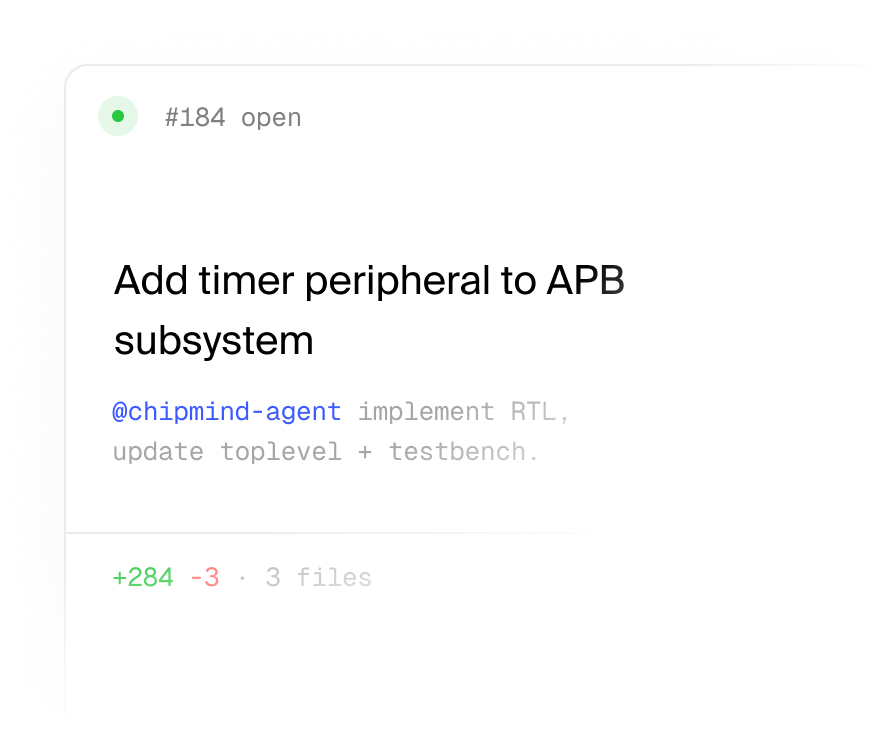
Real-world task focused
Trained and evaluated on real chip design tasks — not synthetic benchmarks.
02
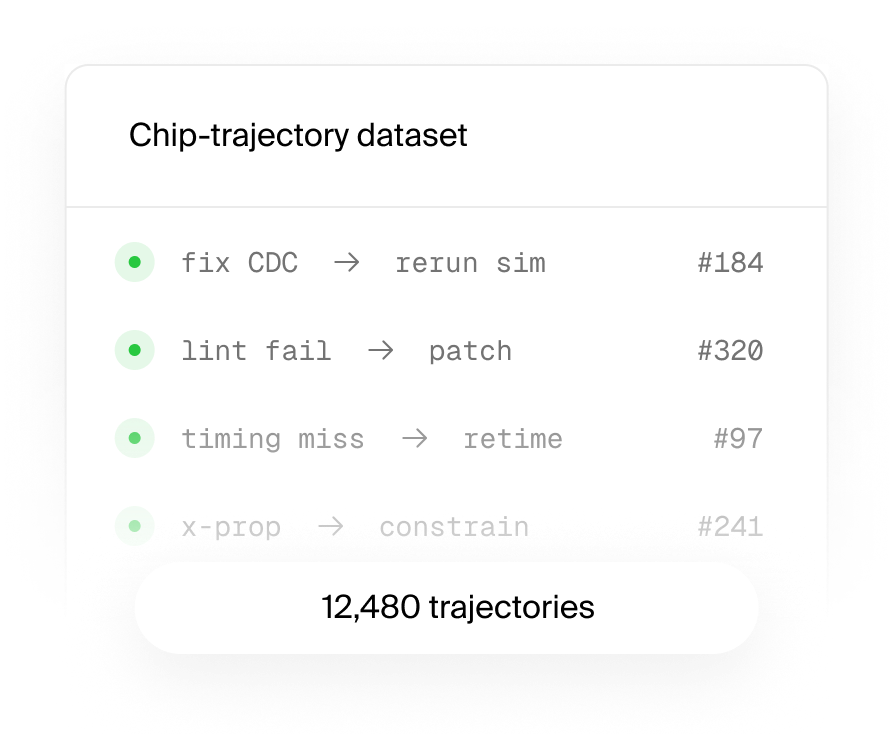
In-house data generation
Task data is generated in in-house learning loops with customers. Customers own it at the end.
03

Flow-aware, not IDE-bound
Understands EDA toolchains, not just HDL syntax.
04
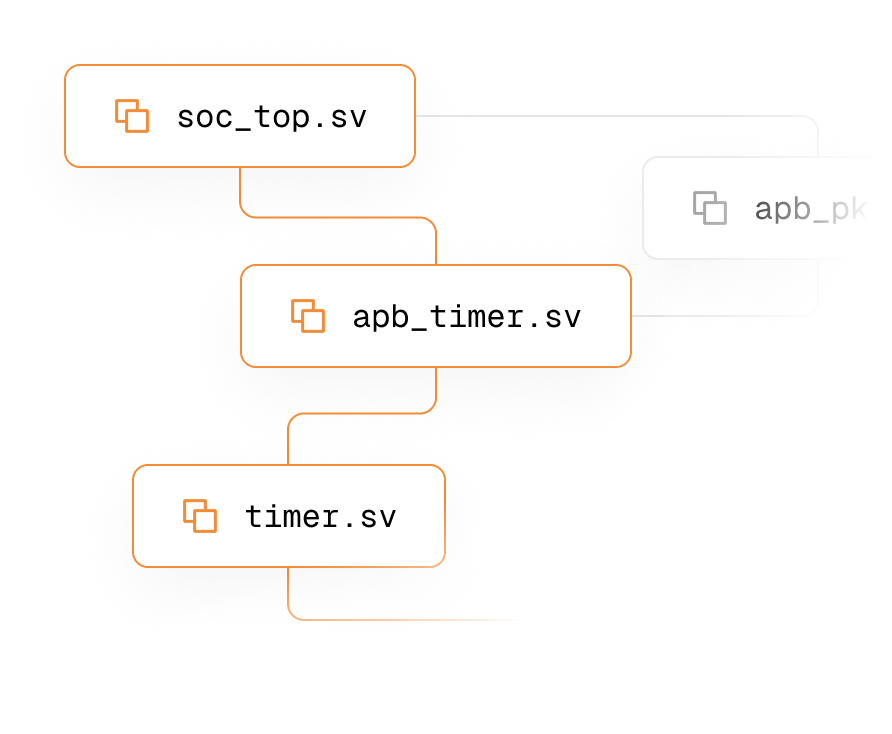
Longevity of in-house data
Modernizes and brings back to life legacy IP — port nodes, refactor interfaces, lift CDC issues.
05
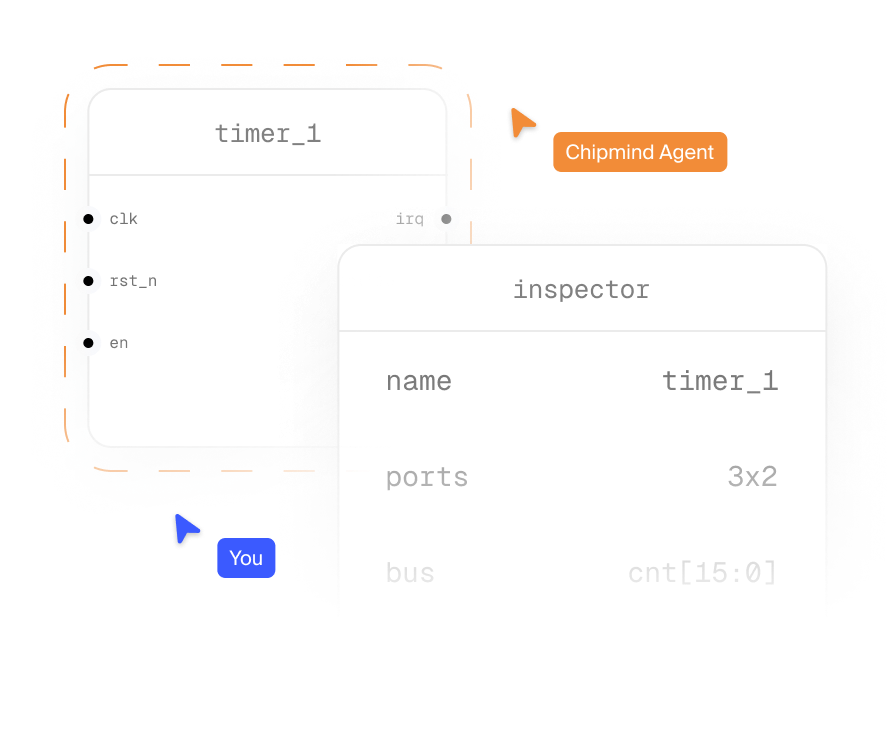
Visual intelligence
Multimodal spatial reasoning over block diagrams, FSMs, waveforms and RTL structures.
06
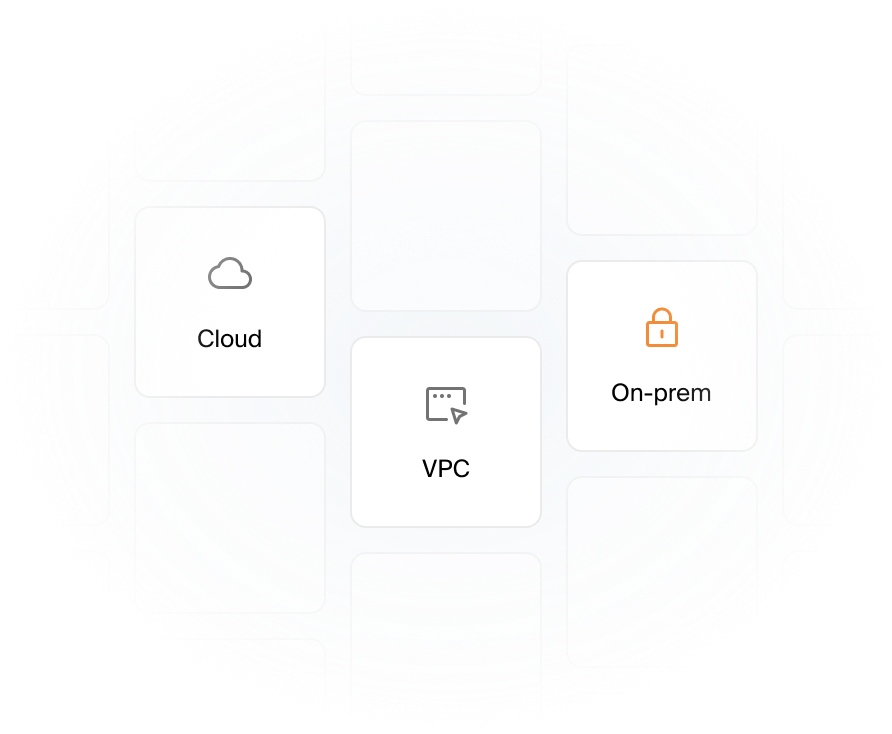
No hyperscaler dependency
Tool-agnostic, LLM-agnostic. Runs wherever you need it — Azure, AWS, or your own VPC.
Where the intelligence comes from.
01
Chip-Trajectory Datasets
Thousands of hours of proprietary, multimodal agent-debugging trajectories feed a continuous self-learning loop. This is how Chipmind learns to navigate EDA toolchains, interpret logs and waveforms, and reason about design flows — before ever touching your data.
02
Context Engineering
Chipmind ingests your complete design files, hierarchies, and constraints into a unified Chipgraph. Custom ACE (Adaptive Context Engine) dynamically retrieves the most relevant context from the Chipgraph for each task through iterative refinement — no fine-tuning required.
03
Value of in-house training data
Agents directly execute EDA tools, analyze logs and waveforms, and learn from results. The longer Chipmind works with your flow, the better it gets at your specific design patterns.
Your design data never leaves your premises.
Browser-based UI on top. Your infrastructure in the middle. Your HPC cluster and your model endpoint at the edge.
01
Browser-based UI
Runs on any laptop with a browser. No install, no per-user provisioning.
02
Server on-prem
The backend deploys into your VPC or data center, and can run fully air-gapped.
03
HPC-ready
Dispatches synthesis, simulation, place & route, DRC/LVS to your cluster.
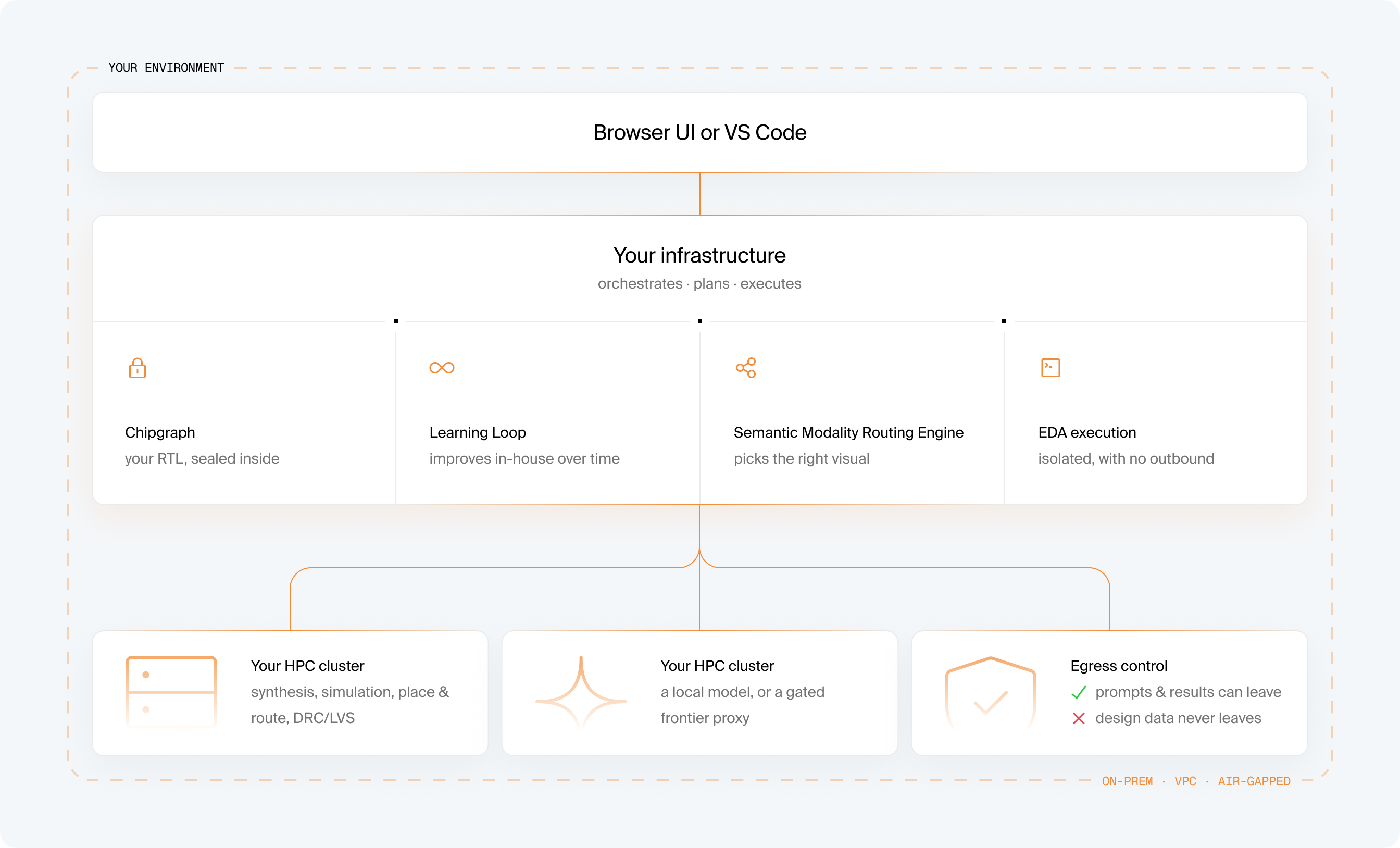
All processing happens on-prem or in your VPC. Chipmind never stores design data beyond the active task.
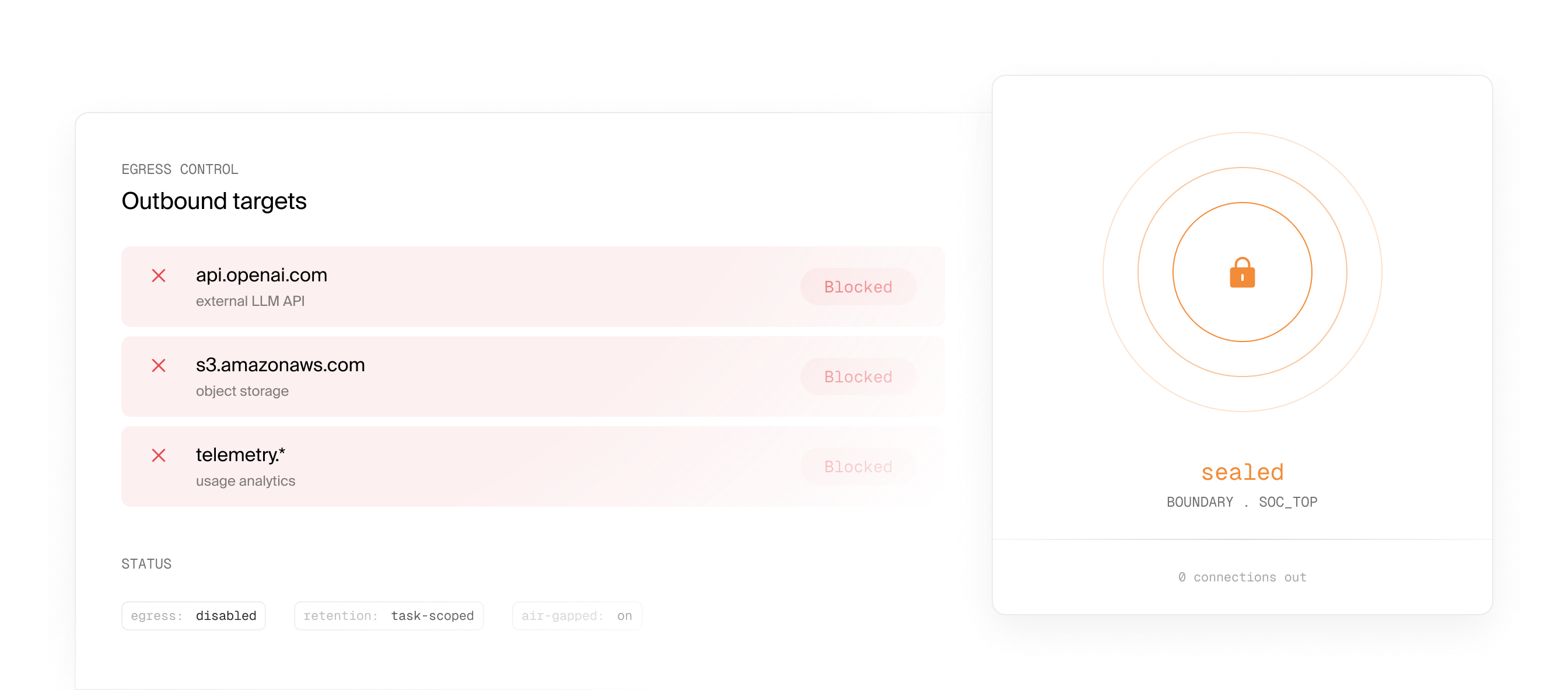
Give agents room to do real work. Keep your environment protected.
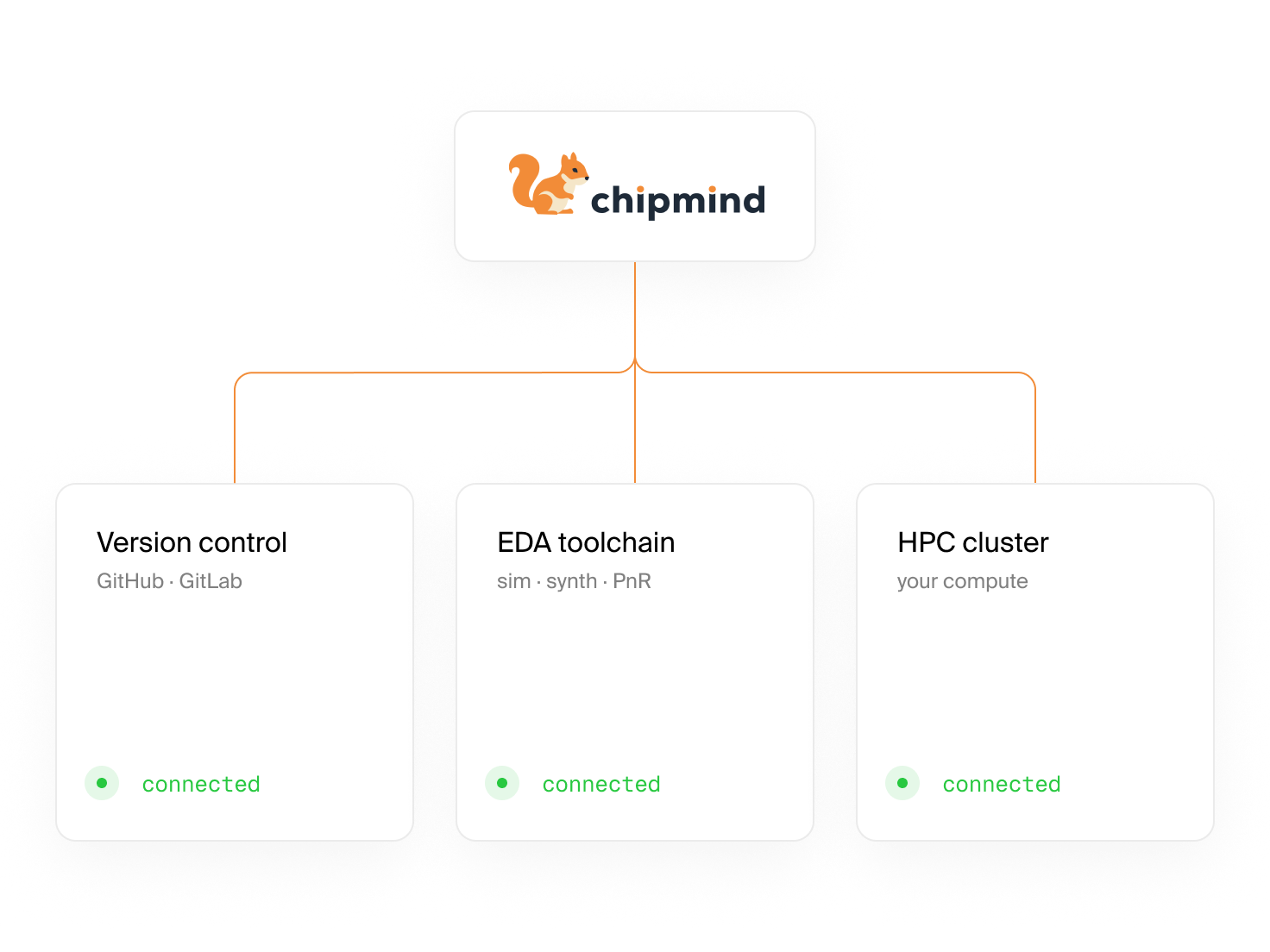
Your environment, your tools.
Chipmind connects to your existing VCS, EDA tools, and HPC cluster. On-prem, VPC, or cloud. Your choice.
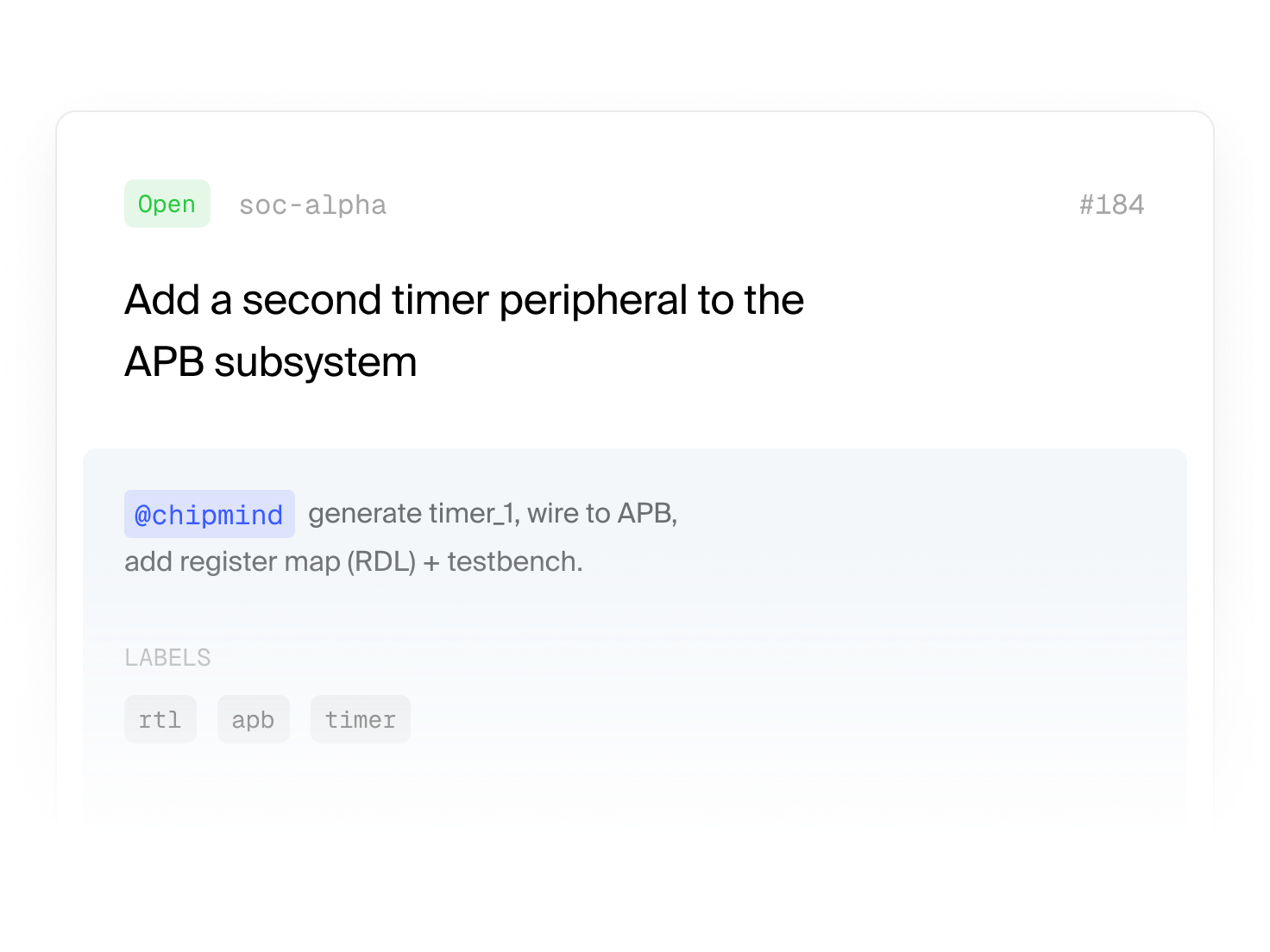
Drop a task in plain English.
Open a GitHub issue, type an @mention, or use the Chipmind GUI. No new syntax and no scripts. Just describe what you need.
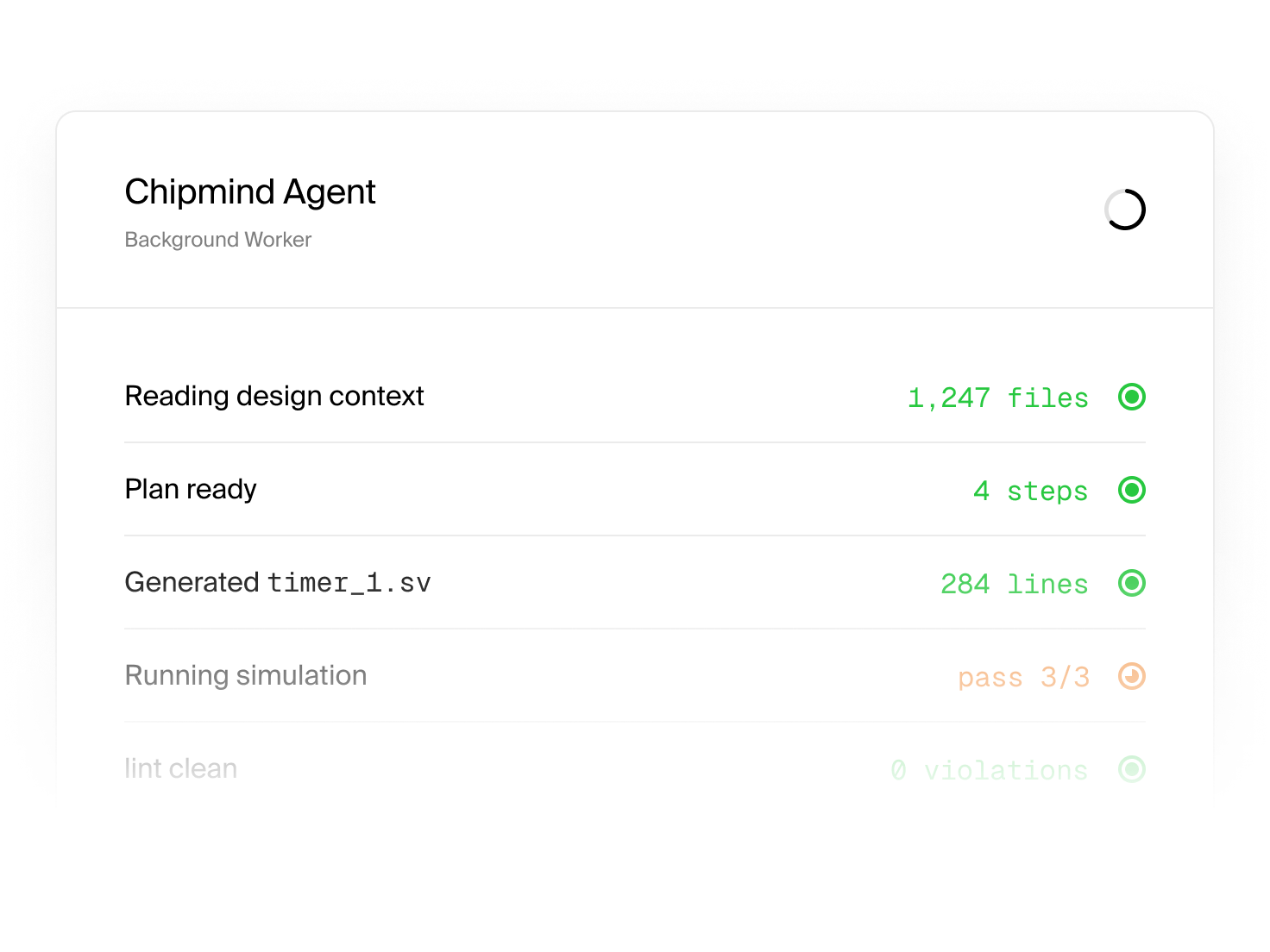
Agents plan and run it autonomously.
The agent reads your design context, plans the task, runs your EDA tools, and iterates until the result is correct.
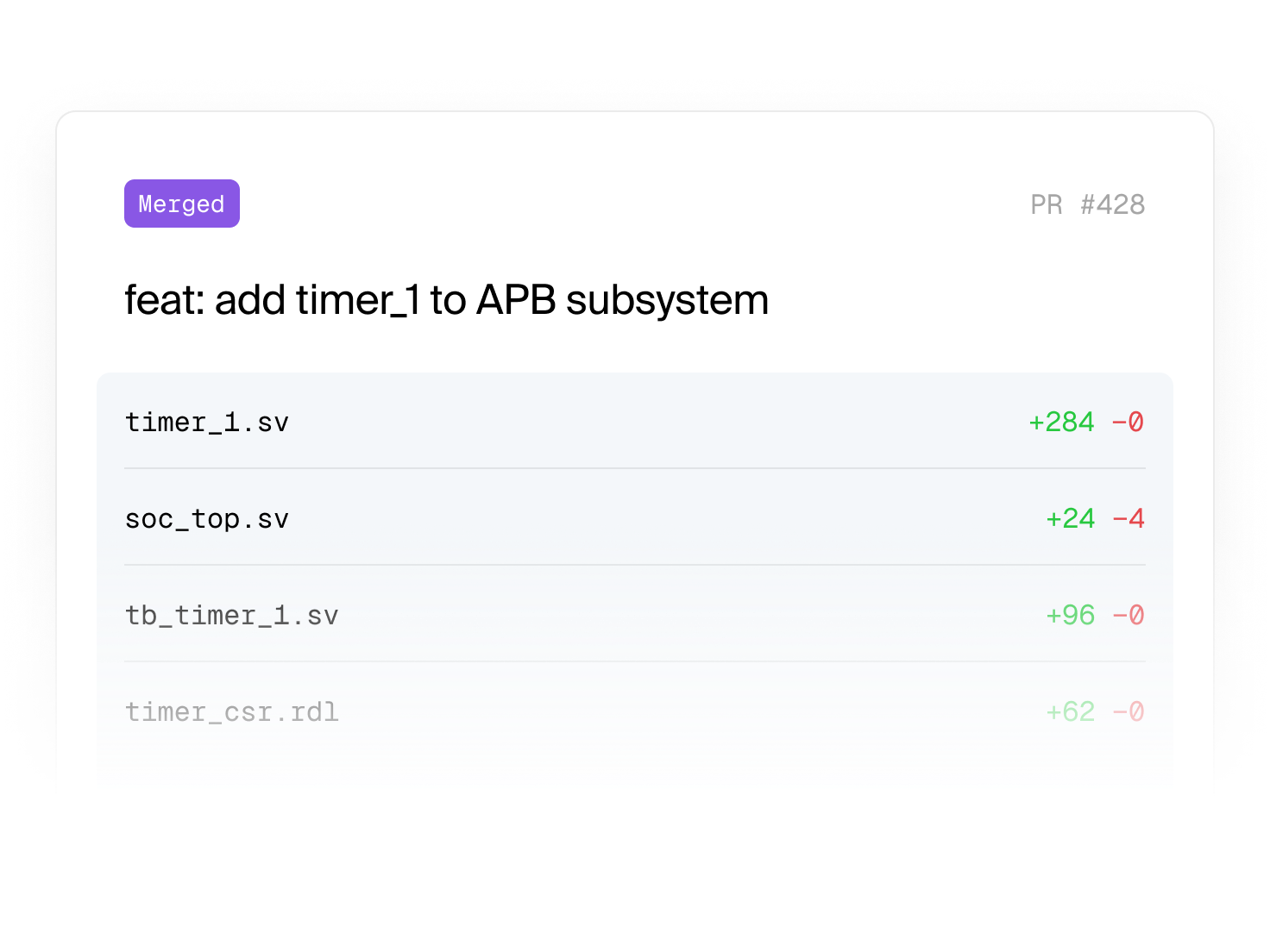
PR ready, with the full execution log.
Results come back as a reviewable PR with full execution log. You stay in control and your agents handle the work.
Backed by & Featured in






FAQ
Chipmind runs inside your own environment, on-prem or in your VPC, next to your HPC or EDA cluster. The harness, Chipgraph and the learning loop run there, under your own access controls.
Chipmind runs inside the flow you already have. The harness is tailored to your SoC and calls your own EDA tools and scripts, so the agents work the way your team works instead of replacing your methodology.
Agents write code faster than engineers can review it. RTL Canvas turns the generated changes back into architecture: added logic in green, removed logic in red, unchanged logic ghosted out. Your engineers review a diagram of what changed instead of reading every line.
The harness learns from verified results and from your engineers' fixes, and this learning stays on your infrastructure. What it learns improves the harness between runs, so more work gets closed more reliably. The acceptance checks themselves stay deterministic.
Trust the process, not the model. The model may propose anything, and its output is never trusted on its own. What gets accepted is decided by deterministic gates in the harness: a golden model, simulation tests, synthesis checks and YAML gates. Same inputs, same verdict.
A candidate that fails is rejected with reasons and goes back to the model. A candidate that passes leaves the harness as verified RTL, with simulation and synthesis evidence your engineers can inspect. That is evidence, not a formal proof. Formal equivalence checking is on our roadmap.
Chipmind builds Chipgraph, a knowledge graph of your design, from your SystemVerilog source. The agents navigate modules, instances, ports and connections through it instead of treating your code as plain text, and Chipmind retrieves the context that matters for each task.
Ready to see Chipmind in action? Book a Call.
Backed by & Featured in

Let AI do the chips.