
Autonomous Chip Design Agents with RTL Canvas as Control Surface.
Drop a task into Chipmind in plain English. A GitHub issue, an @mention, or a chat thread.

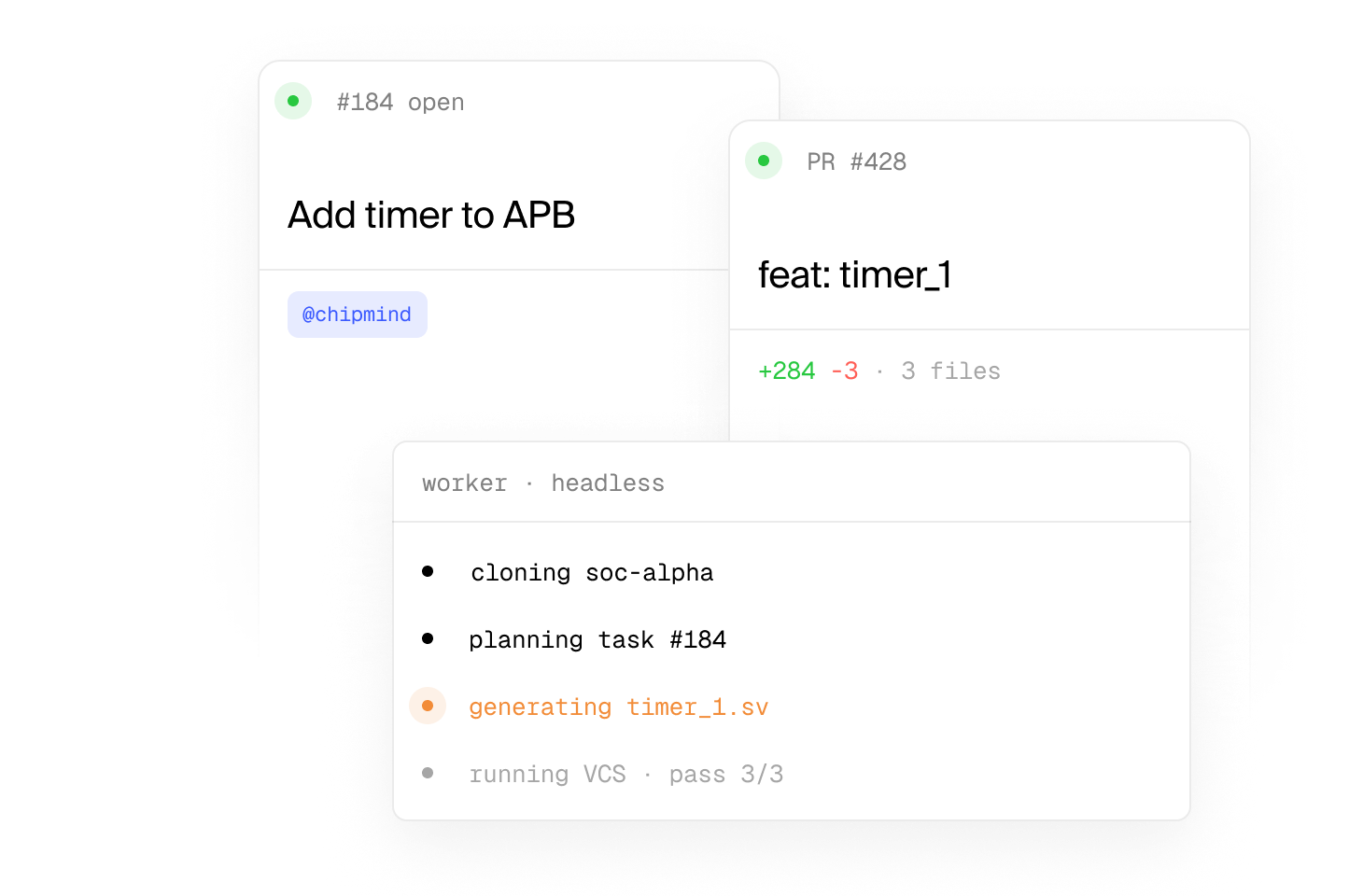
The agent reads your design context, plans the task, runs your EDA tools, and iterates until it's right.
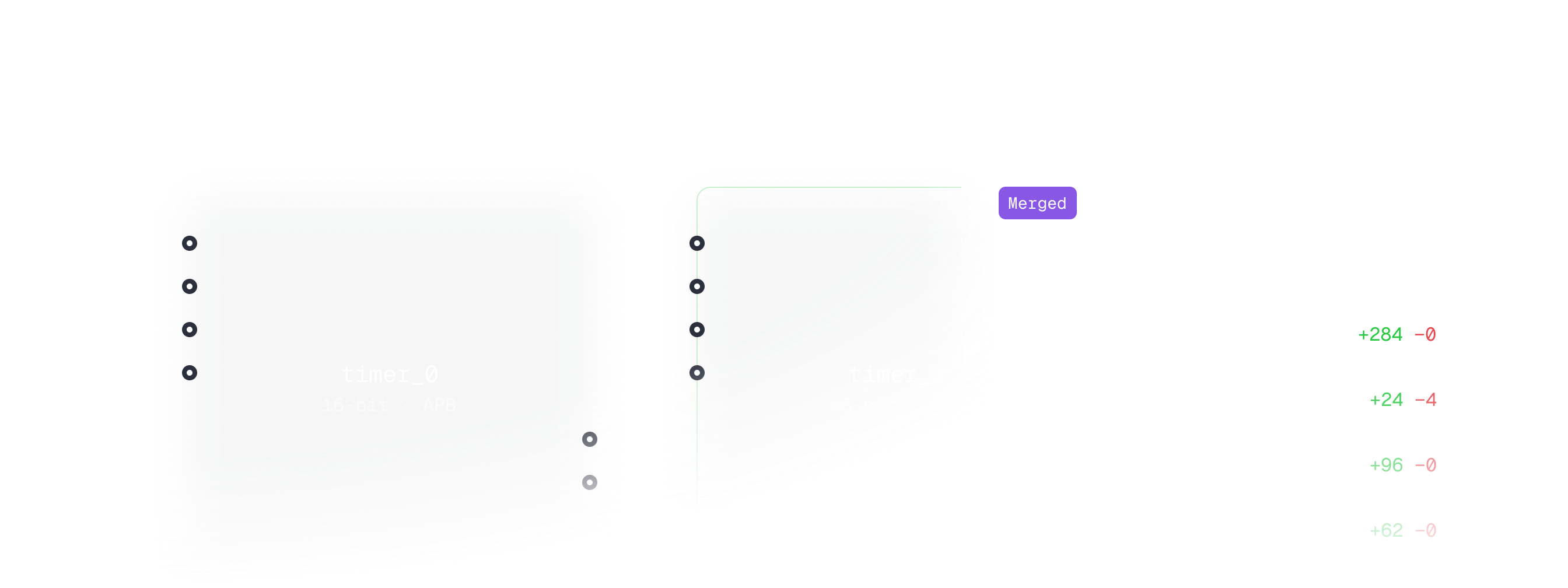
A reviewable PR lands with the diff, generated docs, register maps and a full execution log.
Backed by & Featured in






Tremendously faster towards tape-out with Chipmind.
Before
Chipmind
Result
01
Explore and understand existing IPs
30 min
0:30
20 min
02
Write new RTL module
45 min
2:00
Auto match
03
Update APB bus decoder
15 min
<1 min
15x
04
Extend testbenches
40 min
4 min
10x faster
05
Find bug, implement fix, simulate, iterate
50 min
6 min
Auto fix
06
Open PR with audit log
20 min
auto
Included
Two modes. One Agentic System. Zero disruption.

Mode 01
Interactive Generative UI - RTL Canvas
Work with the RTL of your chip design on the RTL Canvas in real time. The agent user interface runs in your browser or in VS Code. No installation per user.
Task Planner
See what each agent plans for your design anf flow, and why.
Intuitive Interface
Interact with block diagrams and FSMs, drawn live on the RTL Canvas.
VS Code integration
Agent sessions inside your Visual Studio Code IDE.
Chat-based control
Steer agents visually or in plain English.
Mode 02
Autonomous Workers
Assign tasks via GitHub/GitLab issues or by mentioning @chipmind. Chipmind Agent Workers solve them in the background.
Watch the DemoHeadless execution
Long-lived workers behind your CI.
Event-triggered
Fired by issues, labels or webhooks.
Interoperates
Shared state with interactive sessions.
Integrations
Reports back via PRs, MRs, Slack.
Whatever slows you down: Chipmind can take it on.
01

RTL Code Generation
Generate synthesizable HDL from specifications, in your style guide against your constraints set which works for your environment.
02
Verification
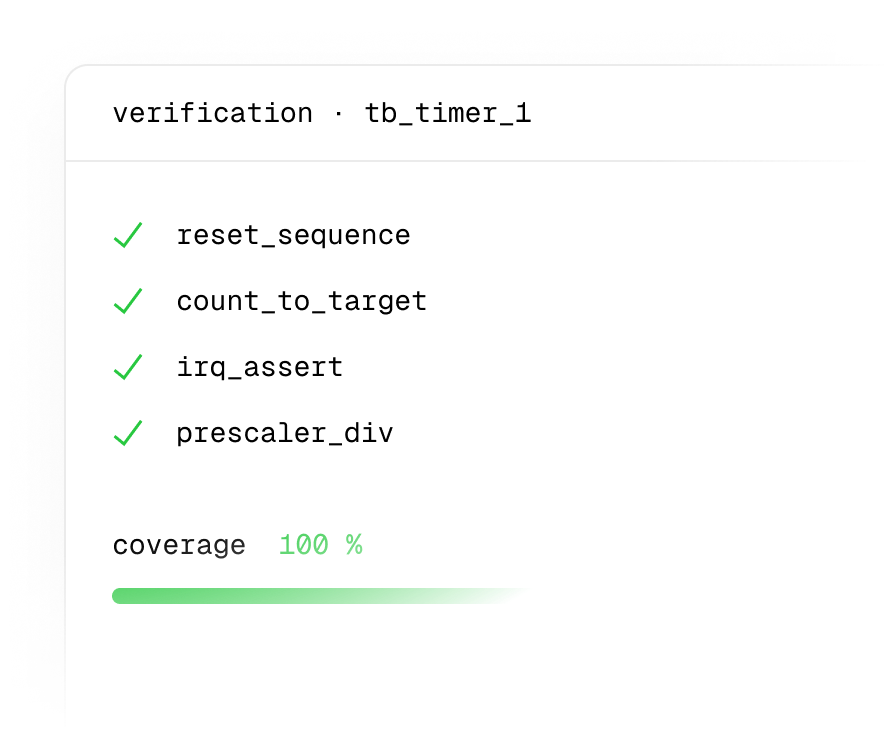
Extends and authors testbenches, triages test runs and closes regression loops unattended.
03
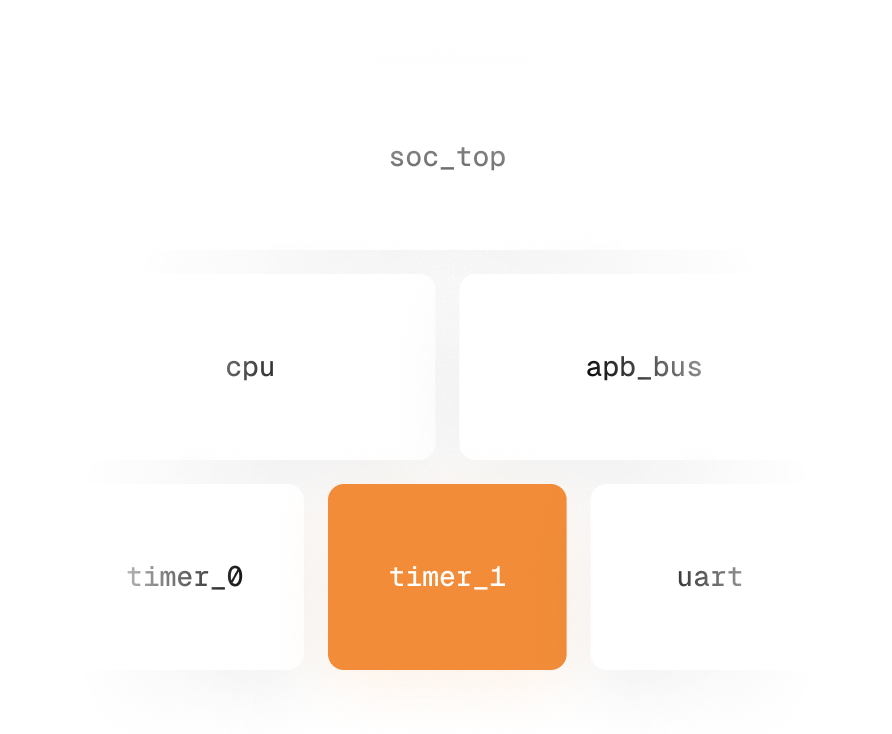
Documentation & Visualization
Generates block diagrams, register maps and engineer-readable specs from your RTL.
04
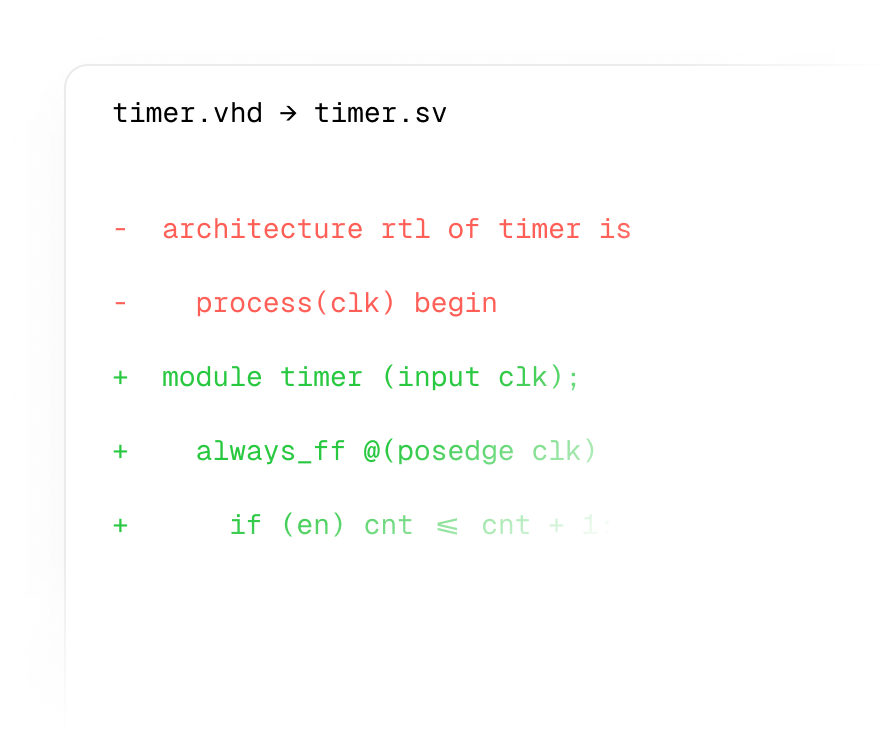
Refactoring & Maintenance
Modernizes and brings back to life legacy IP — port nodes, refactor interfaces, lift CDC issues.
05
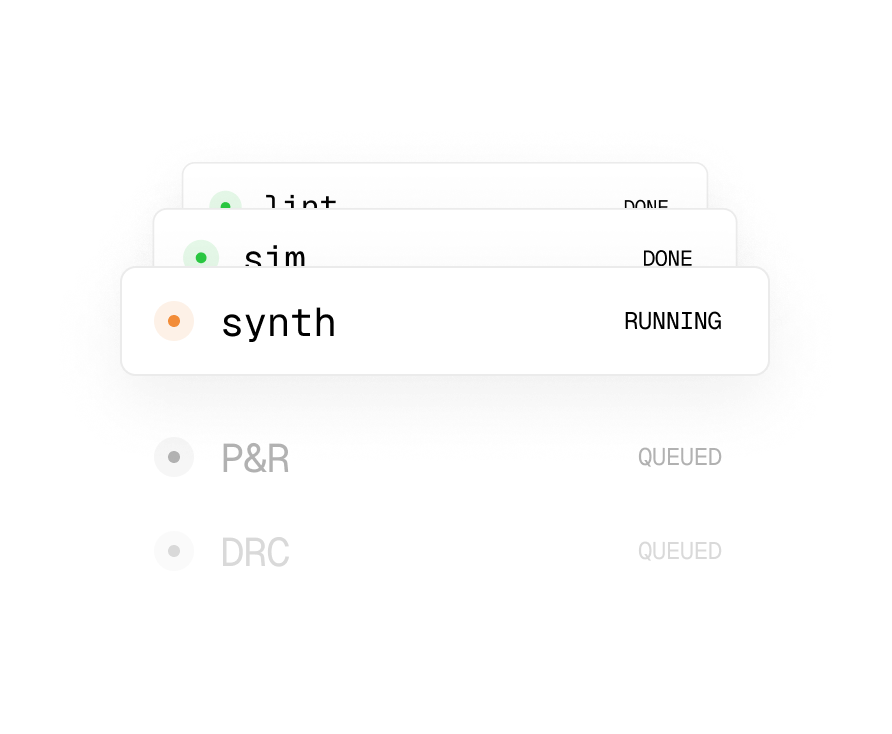
Integration & Flow
Drives lint, simulation, synthesis and regression scripts as a single goal-driven loop.
06

Adaptation
Learns your team's conventions and constraints. Sharper with every task.
Chipmind talks to your tools. And to other agents.
IDE & Version control

VS Code
Extension for interactive agent sessions inside your IDE

GitHub
Issues, PRs, CI/CD triggers, @mention to assign tasks

GitLab
Full GitLab integration — issues, merge requests, pipelines
Simulation & synthesis

Verilator
Open-source RTL simulator — fast, cycle-accurate simulation

YosysHQ
Open-source synthesis & formal verification (Yosys)

Surfer
Open-source waveform viewer — inspect simulation traces

OpenROAD
Open-source RTL-to-GDS — synthesis & place-and-route

Synopsys
VCS simulation, Design Compiler synthesis, PrimeTime timing

Cadence
Xcelium simulation, Genus synthesis, Innovus implementation

Siemens EDA
Questa simulation & functional verification
Open hardware ecosystem

RISC-V
Open ISA — Chipmind understands RISC-V cores & extensions

OpenTitan
Open-source silicon root-of-trust project

PULP Platform
Open-source RISC-V SoC platform (ETH Zürich / Bologna)
API & Agent protocols

REST API
Programmatic access — trigger tasks, query status, retrieve results

MCP
Model Context Protocol — connect agents to external tools and data sources

ACP
Agent Communication Protocol — Chipmind agents talk to other AI agents
Chipmind Agents don't just work alone.
Via MCP and ACP, they interoperate with other AI agents in your organization — sharing context, delegating sub-tasks, and coordinating across tools.

01
Multi-agent orchestration
One agent plans, others execute. Tasks fan out and reconverge automatically.
02
Cross-tool context sharing
Design context flows between Chipmind and your other in-house agents — without re-ingestion.
03
Open protocol based
Built on MCP and ACP — not a proprietary lock-in. Talks to whatever you already run.
Your data and IP never leaves your premises.
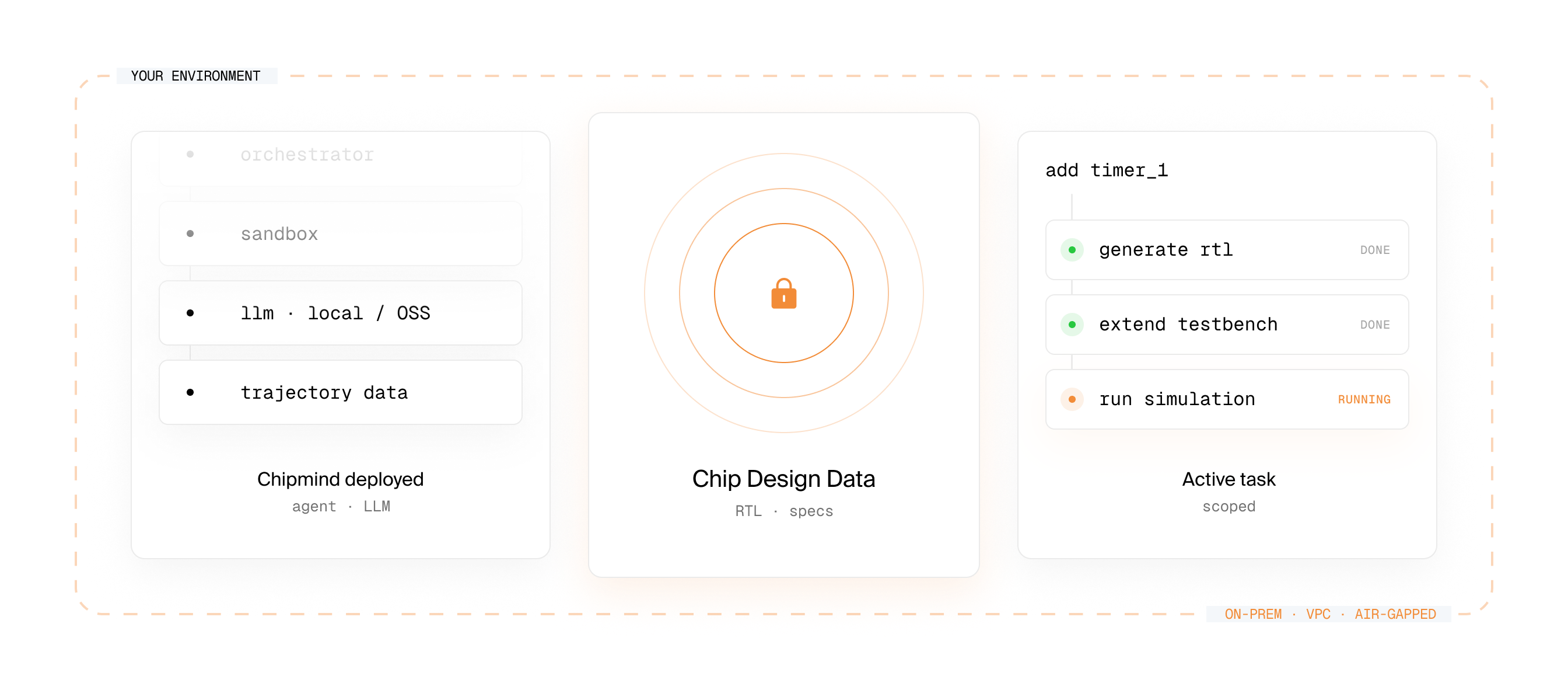
Three guarantees, baked into every deployment. Chipmind is built for teams whose IP must never leave the building.
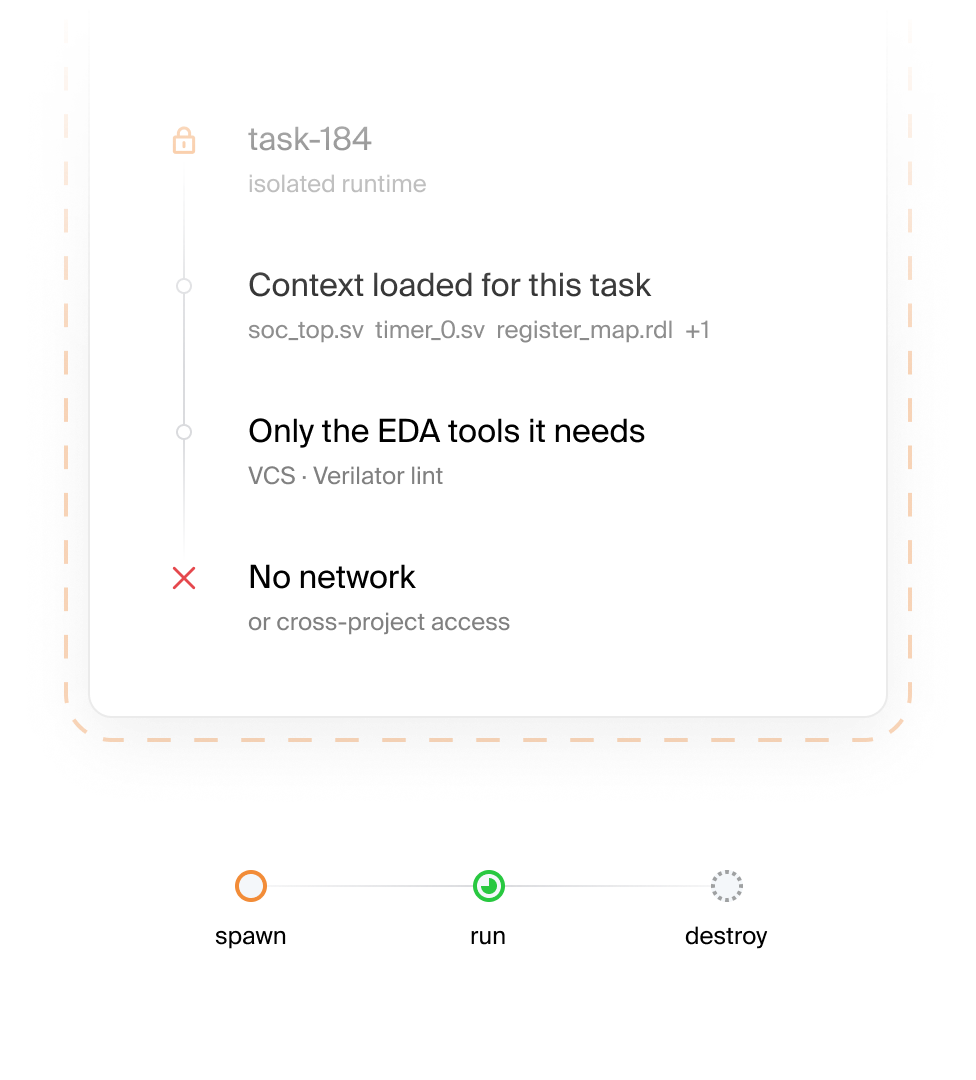
01
Isolated execution environments
Every agent task runs in a contained, ephemeral runtime. No cross-project leakage, no persistent access. Design context is loaded per task and cleaned up on completion.

02
Full data-confidentiality
Your design files, RTL and simulation results never leave your environment and premises beyond the active task. All training steps performed in-house, no training data shared outside.

03
Execution Security
Every agent action — files read, commands executed, decisions made — is logged and reviewable. Custom Guardrails for controlled command execution.
Compatible with your existing stack.
EDA-tool agnostic. LLM-agnostic. If it has a scripting or CLI interface, Chipmind can use it.














FAQ
Instead of forcing engineers to line-read raw HDL code deltas, the platform translates textual code changes into a clear structural diagram. Added logic gates or clock domains are highlighted in green, removed pieces in red, and unchanged code is ghosted out.
Not at all. Engineers retain full control through a secure Staging Loop. This real-time sandbox lets humans prototype and visually review architectural variations before the AI modifies any production code.
Yes. Chipmind is completely EDA tool-agnostic. It is designed to integrate seamlessly into your existing ecosystem, working with open-source EDA tools, commercial suites from major vendors, and custom in-house scripts.
Chipmind Agents are collaborative, design-aware and visually interactive AI assistants engineered to autonomously handle repetitive, low-level chip design, verification, and review tasks, saving engineering teams from handholding coding agents.
Ready to see Chipmind in action? Book a Call.
Backed by & Featured in

Let AI do the chips.