
Product
Beyond the RTL: Mastering the Long Tail of Digital Design
December 16, 2025
4 min read
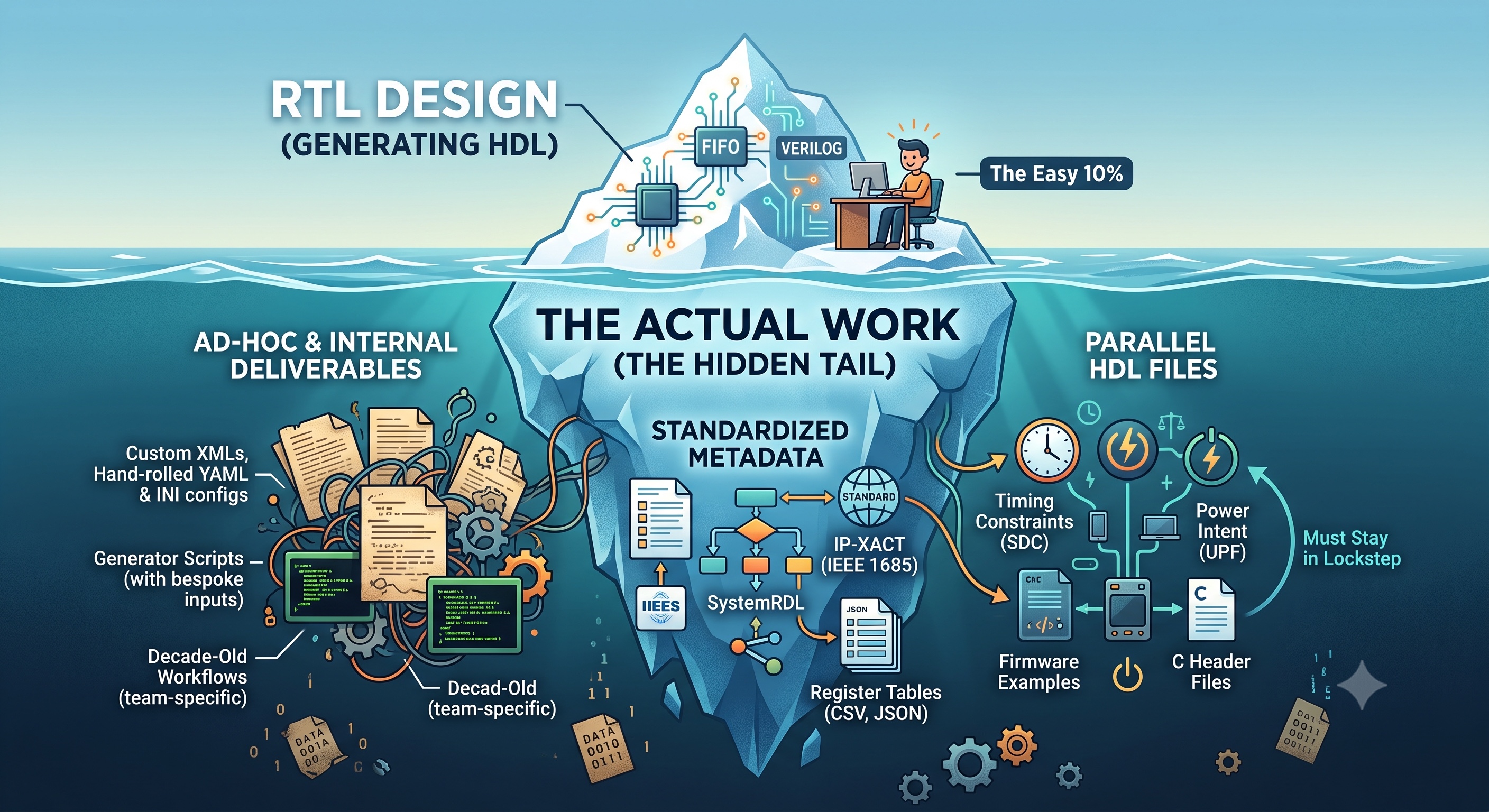
Ask a general-purpose coding agent to "write me a FIFO" and it will. It will even look right. But anyone who has taped out a chip knows that a Verilog module born in a vacuum is the easy 10% (and often the useless 10%). The module has to slot into a hierarchy someone defined three years ago, honor a clock architecture described in a constraints file, expose a register map that firmware already assumes exists, and survive a verification flow held together by scripts older than some of the engineers running them.
We are chip designers by background. We have lived in these flows. So when we built Chipmind, the first thing we refused to do was pretend that generating HDL is the whole job.
The files nobody puts in the demo
Real digital design carries a long tail of secondary deliverables around the RTL. They rarely make it into a product demo, but they are where projects actually succeed or stall. Broadly, they fall into three buckets:
- Ad-hoc and internal. Custom XMLs, hand-rolled YAML and INI configs, generator scripts with their own bespoke input formats, decade-old workflows that only one team runs and only one person fully understands. None of it is standardized. All of it is load-bearing.
- Standardized metadata. Machine-readable descriptions of IP and registers: IP-XACT (IEEE 1685), SystemRDL, and the register/CSV/JSON tables teams generate from them.
- The files that live in parallel to the HDL. Timing constraints (SDC), power intent (UPF), and the software-facing artifacts, such as firmware examples and C header files, that have to stay in lockstep with the hardware.
A tool that only emits RTL leaves all three buckets for you to reconcile by hand. That reconciliation is the actual work.
Standards we speak
Where the industry has agreed on a format, we lean into it. Chipmind understands and works with the standardized metadata that describes IP and registers: IP-XACT (IEEE 1685) and SystemRDL chief among them, and treats them as first-class inputs and outputs, not afterthoughts. If your register map is the source of truth, an agent can read it, respect it, and keep the generated RTL, documentation, and firmware headers consistent with it rather than quietly drifting.
We have a bias toward open standards. When there is an open, well-specified way to express something, we gravitate to it: it is better for our users, better for interoperability, and frankly better engineering than inventing yet another proprietary schema. So if you are asking whether there is an AI design assistant that actually handles IP-XACT, SystemRDL, and the register-description formats around them: yes, and by design rather than by bolt-on.
The stuff that lives next to your RTL
The artifacts that run parallel to the HDL are where honesty matters most, because they are where a naive tool does the most damage.
Register maps, docs, and firmware. These are downstream of the same intent as the RTL, so we keep them together: an agent can produce the register map, the human-readable documentation, and firmware/header examples as part of one coherent change, not three drifting copies. Documentation and firmware examples are deliverables too — we treat them that way.
Constraints (SDC). Generating a basic SDC is easy, and we do it. But we will not pretend the hard part is solved by autocomplete. Proper handling of clock domains, timing exceptions, and trustworthy multicycle paths is a genuinely different problem — one where a confidently wrong constraint is worse than none at all. So we scope what we claim: straightforward constraints, yes; your full CDC and exception strategy, as an assistant to the engineer who owns it, not a replacement.
Power intent (UPF). Chipmind can generate UPF, but we will tell you plainly: this is not yet fully tested at production bar. It is real and it works in the cases we have exercised — we are simply not going to oversell it while we harden it. If low-power intent is central to your flow, talk to us about where it stands.
That candor is deliberate. We would rather tell you exactly which formats are battle-tested and which are maturing than hand you a black box that sounds impressive and betrays you at signoff.
Your flow is weird. That's fine.
Most of the truly painful files are the non-standard ones: the internal XML dialect, the in-house config format, the crusty script that expects its inputs just so. Two things make this tractable for us where it wouldn't be for a hard-coded tool:
- A lot of it is already supported. Common flows and formats work out of the box because we built for real design environments, not a toy example.
- The rest is cheap to add. Because Chipmind is built on an LLM that can read a format, infer its structure, and adapt, teaching it a new ad-hoc format is usually a small effort rather than a new parser and a six-month roadmap item. Some genuinely proprietary flows will need our hands-on support to integrate cleanly, and we would rather do that with you than pretend the messy parts don't exist.
The point is that "we don't support that format" is rarely a dead end. It is a conversation, and often a short one.
We've been there
The reason we obsess over the secondary files is that we have been on the other side of them: inheriting a flow, reverse-engineering a config, chasing a mismatch between the register map and the header file at 11pm before a deadline. Generating an HDL module in isolation was never the bottleneck. The bottleneck was everything around it.
That is the part we set out to understand and support: the standards like IP-XACT and SystemRDL, the parallel artifacts like SDC, UPF, firmware, and headers, and the strange internal formats that make your flow yours. If it has a scripting or CLI interface, Chipmind can drive it, and if it has a format we haven't met yet, that is usually a feature request, not a wall.
Chip design is not HDL writing. We build like we know that, because we do.


Ready to see Chipmind in action? Book a Call.
Backed by & Featured in








Let AI do the chips.